
If you got a letter from Capital One in 2019 or 2020 telling you your information may have been exposed, there is a date next week that matters more than anything else you will read about this case. It is September 11, 2026. It is not a claim deadline.
Capital One has agreed to pay $35,000,000 to settle the claims of class members in Canada outside Quebec. The B.C. Supreme Court has not approved it yet. The hearing is September 22, 2026. Until then, nobody can file a claim — the settlement administrator says so in plain words on its own site: you cannot make a claim until after the settlement is approved and the claims period begins.
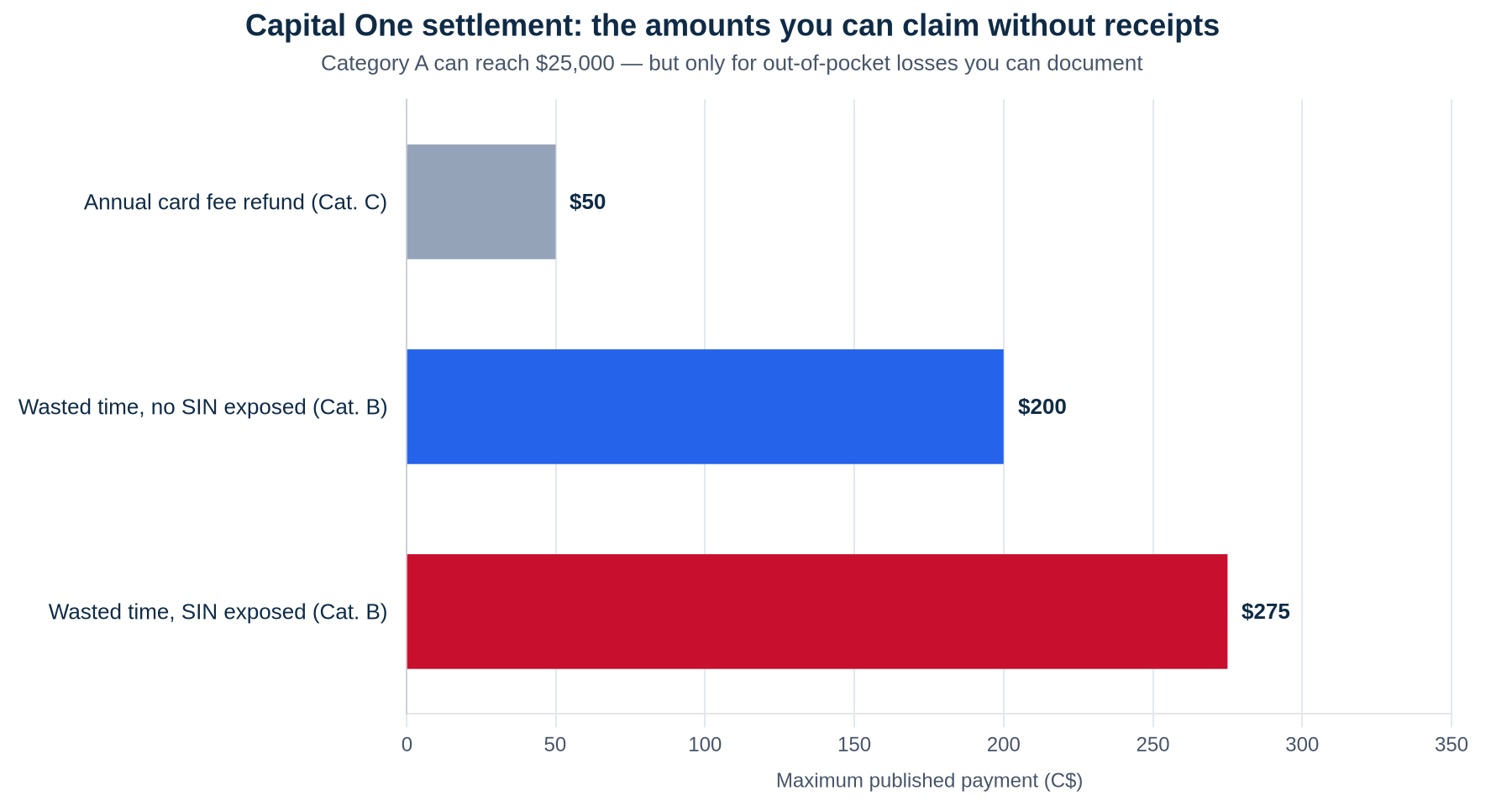
Meanwhile, sites are running headlines promising Canadians “up to $25,000.” That number is real. It is also the single most misleading figure in this settlement, and the chart below shows why.
What the $25,000 actually is
The claims program has three categories, and only one of them reaches five figures.
Category A — up to $25,000. This is reimbursement for documented out-of-pocket costs traceable to the breach. Documented. That means receipts, statements, invoices, proof that money left your hands because of what happened in 2019. If you spent nothing, you claim nothing here. The overwhelming majority of the roughly six million affected Canadians spent nothing.
Category B — $200 or $275. This is compensation for time and inconvenience, and it is the category most people will actually use. Class members whose social insurance number was not involved can claim up to five hours, or $125, plus a $75 top-up: $200. Class members whose SIN was compromised can claim up to eight hours, or $200, plus the same $75 top-up: $275.
Category C — up to $50. Repayment of annual credit card fees.
The published legal notice adds one more line worth knowing: depending on how many claims are made, class members could receive up to another $750. “Depending on how many claims are made” is the entire story of this settlement. A $35 million fund covering a class of roughly six million people works out to under $6 a head if everyone files. It will not be everyone. Nobody knows what the real number will be, and be sceptical of any site that gives you a firm per-person figure before the claims period has even opened.
Who is in, who is out
You are in the class if you live in Canada outside Quebec, you applied for or were issued a Capital One credit card, and you received a letter from Capital One in 2019 or 2020 telling you your information may have been subject to unauthorized access.
Quebec residents are excluded from this settlement entirely. There is a separate Quebec class action over the same breach, run by different counsel. It was authorized on August 10, 2023, went through an appeal judgment on February 25, 2025, and has not settled. If you live in Quebec, the $35 million is not yours to claim and no deadline next week applies to you. Watch the Quebec file on its own.
What happened, briefly
Someone got into Capital One’s systems on March 22 and 23, 2019. Capital One discovered it on July 19 and made it public at the end of that month. Approximately six million individuals in Canada were affected. Approximately one million Canadian credit card customers had a social insurance number compromised. Credit card application data, credit scores, credit limits, balances and payment history were involved, along with fragments of transaction data from 23 days across 2016, 2017 and 2018. No login credentials were compromised.
That distinction — SIN exposed or not — is the one that decides whether your Category B claim is worth $200 or $275. Your 2019 letter said which. If you no longer have it, the administrator is the place to ask.
Why this is taking so long
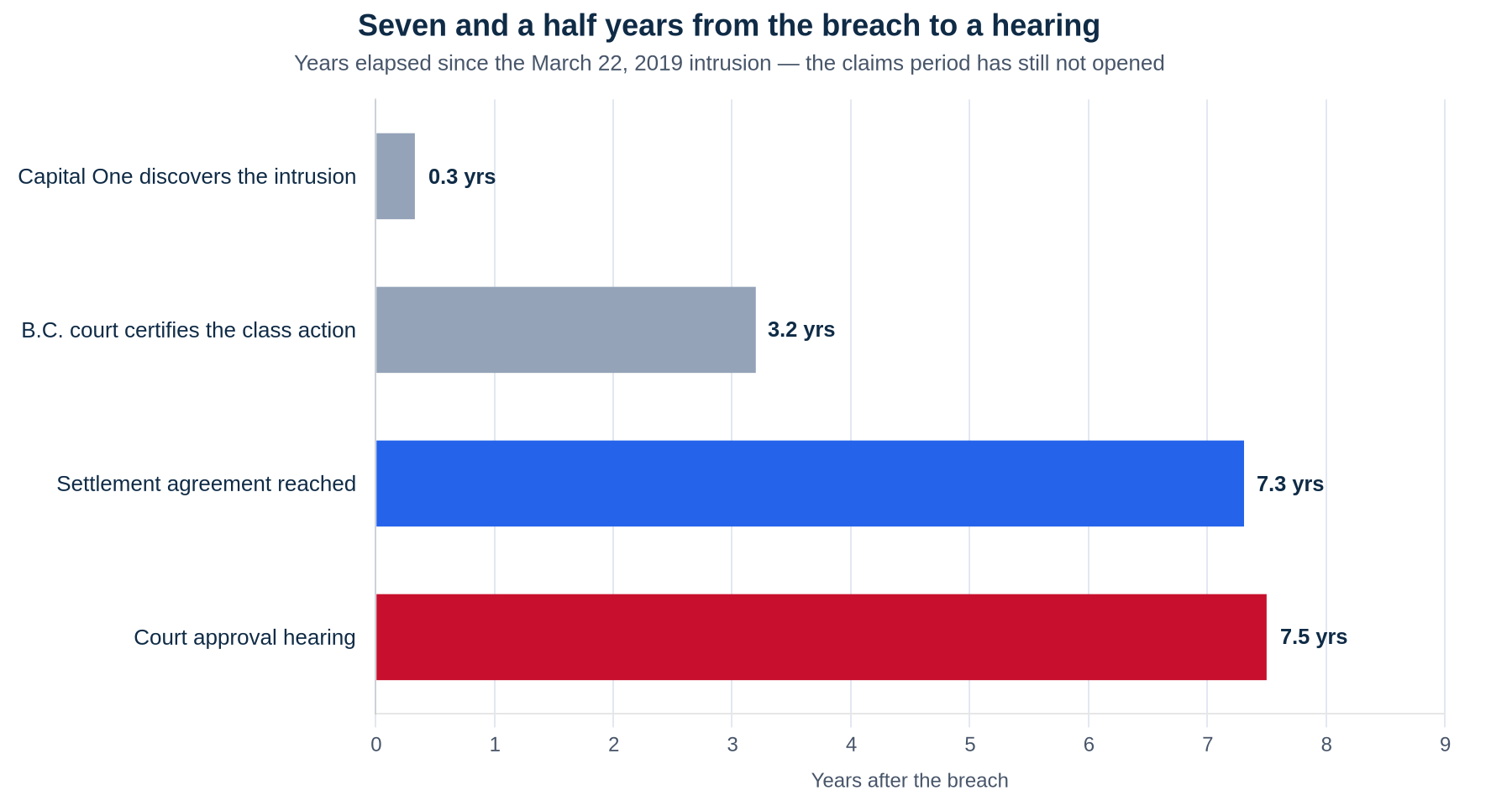
Three years from breach to certification. Four more from certification to a signed settlement. Seven and a half years in, the court has still not approved anything and not one claim form has been accepted.
This is normal, and it is the mechanism people misunderstand. A Canadian class action has to be certified before it can go anywhere, then litigated or negotiated, then settled, then approved by a judge, and only then does an administrator open a claims portal and start processing. Each stage can add years. The Government of Canada online account breach ran on a similar clock: attacks in 2020, claims opening in August 2026.
The practical consequence for you is that there is nothing to file today and there may be nothing to file for months. What there is, right now, is a decision to make by September 11.
The September 11 decision
Deadline: September 11, 2026, for both opting out and objecting.
If your opt-out form is not received by that date, you are a member of the class and bound by the settlement if the court approves it. For almost everyone, that is the right outcome — staying in costs you nothing and preserves your ability to claim later. Opting out only makes sense if you intend to sue Capital One yourself over this breach, which is a decision to take to a lawyer, not to a comment section.
Objecting is different. It means you stay in the class but tell the court you think the settlement is unfair. That also has to be in by September 11.
What to do this week
Decide by September 11 whether you are staying in. If you do nothing, you stay in. That is the default and, for most people, the correct one. Do not let a headline about $25,000 push you into an opt-out you do not understand.
Find your 2019 or 2020 letter. It establishes that you are in the class and it tells you whether your SIN was involved. Search old email as well as paper files. If you have moved since 2019, the letter went to the old address — the administrator can help you confirm your status.
Start a receipts folder now if you had real losses. Category A is the only route to a large payment and it is documentation-only. Credit monitoring you paid for, fraud you had to unwind, fees you were charged — gather the proof while the claims period is still ahead of you, not after it opens.
Do not pay anyone to file this claim. There is no claim to file yet, which makes any “filing service” charging you today doubly worthless. When the claims period does open it will be free, and class counsel fees come out of the approved $35 million, not out of your pocket. Nobody has special access to an administrator.
Expect phishing. Every approval hearing and every benefit change produces a wave of it — the switch from the GST/HST credit to the Canada Groceries and Essentials Benefit did exactly that this summer. A text or email offering to release your Capital One settlement money in exchange for your banking details is a fraud, without exception. Go to the administrator’s site directly, and check anything government-related in CRA My Account yourself.
Do not confuse this with the American case. Capital One settlements in the United States are separate proceedings with their own funds, rules and dollar figures. None of them pay Canadians. If a page quotes a U.S. number at you, it is not describing your claim. And if you are weighing several claims at once, our verified calendar of Canadian claim deadlines shows which ones actually close in the next seven weeks.
More open settlements
- Two CIBC Mutual Fund Settlements Are Open at Once — Which One Applies
- $7.5M Silk and Great Value Recall Settlement: Who Can Actually Claim
- Scotiabank $10.45M Settlement: Are You One of the 148,000?
- Canada’s $32.5 Billion Tobacco Settlement and the Claim Window That Runs to 2027
Figures, dates and eligibility rules verified as of September 4, 2026 against the settlement administrator at capitalone2019classaction.ca, the legal notice published by class counsel, and Capital One’s own 2019 cyber incident page. This article is general information, not legal or financial advice. The settlement is not approved yet and its terms can change. Always confirm on the official settlement website or with class counsel before opting out, objecting or filing.

Tyler Bernick is a content writer covering Canadian settlement updates, scam alerts, and consumer rights. He aims to simplify complex legal topics and provide clear, reliable information to help Canadians make informed decisions.
Discover more from Settlement Alerts
Subscribe to get the latest posts sent to your email.