
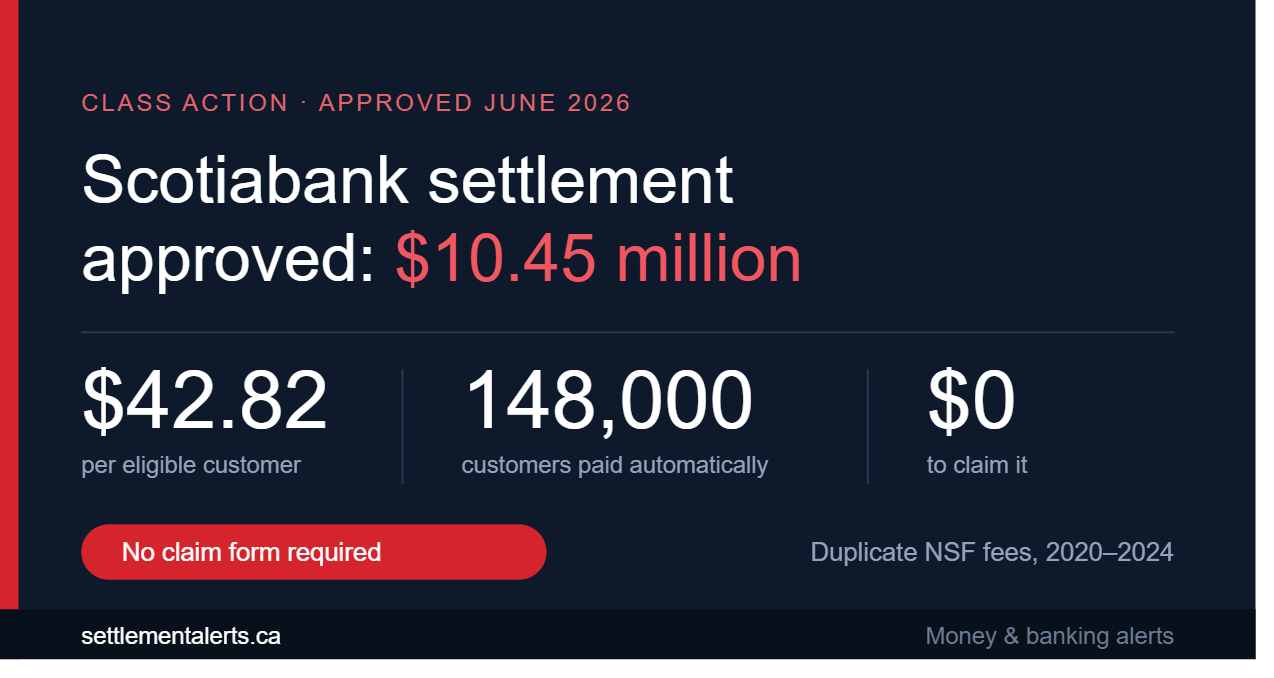
If you banked with Scotiabank between 2020 and 2024 and ever had a bill bounce, check your account balance this month. A court-approved class action settlement is about to put money back where it came from — and unlike most settlements, you do not have to apply for it.
On June 12, 2026, the Ontario Superior Court of Justice approved a $10,450,000 settlement in a class action against The Bank of Nova Scotia over duplicate non-sufficient funds (NSF) fees. Class counsel Koskie Minsky LLP published the approval notice on July 14, 2026. Roughly 148,000 personal banking customers are covered.
This guide breaks down exactly who qualifies for the Scotiabank settlement, how much each person receives, when the money lands, how it compares to the TD, RBC and CIBC settlements, and what Canada’s new $10 NSF fee cap means for you going forward — with a specific section for newcomers, who are hit by these fees more often than almost anyone else.
Table of contents
- What the Scotiabank class action was about
- Scotiabank settlement eligibility: do you qualify?
- How much is the payout and when does it arrive?
- How to spot settlement scams
- TD, RBC, CIBC and BMO: the other bank settlements
- Canada’s new $10 NSF fee cap explained
- Why NSF fees hit newcomers hardest
- Frequently asked questions
What the Scotiabank class action was about
The case is formally titled Canaan Alexander v. The Bank of Nova Scotia. It targeted one narrow but expensive billing practice involving pre-authorized debits (PADs) — the automatic withdrawals that cover rent, phone plans, insurance premiums, gym memberships and streaming subscriptions.
Picture the sequence the lawsuit described:
- A merchant tries to pull a payment from your Scotiabank account.
- Your balance is short, the payment is declined, and Scotiabank charges a $48 NSF fee.
- A few days later, the same merchant automatically re-submits the identical payment.
- Your balance is still short — and Scotiabank charges a second $48 NSF fee.
The class action argued that second fee was duplicative. You had no control over whether or when a third-party merchant would re-present the payment through the clearing system, yet you were penalised twice for what was effectively one failed transaction. A $25 subscription charge could turn into $96 in bank penalties inside a month.
Scotiabank has not admitted liability and continues to deny the allegations. As with most class action settlements in Canada, the agreement resolves the dispute without any court finding that the bank broke the law. The class was certified by the Ontario Superior Court of Justice on April 8, 2024, and the settlement was reached with the help of a mediator on January 21, 2026.
Scotiabank settlement eligibility: do you qualify?
Eligibility is defined tightly, and all of the conditions below must apply:
- You are or were a personal deposit account holder with Scotiabank, resident in Canada.
- Between June 21, 2020 and April 30, 2024, you were charged a $48 NSF fee on a pre-authorized debit.
- You were charged a second $48 NSF fee between 2 and 30 days later on a PAD from the same merchant, for the same dollar amount, with the same transaction code and description.
- You still hold an active Scotiabank personal deposit account that the funds can be deposited into.
Not covered: business and corporate accounts, credit card late fees, overdraft interest, and merchant-side returned-payment fees. The class is limited to personal deposit accounts.
You do not need to dig through four years of statements to check. Scotiabank is identifying eligible customers using its own internal transaction records.
How much is the payout and when does it arrive?
Scotiabank will deposit approximately $42.82 directly into the accounts of approximately 148,000 eligible customers, according to the notice issued after court approval.
That amount is a pro rata share. The $10.45 million fund is reduced by court-approved legal fees, administration costs and other expenses, and what remains is split among eligible class members. Earlier notices estimated roughly $40 per person, so the final figure came in slightly higher.
Do I need to file a claim?
No. There is no claim form, no online portal, no deadline. This is one of the rare consumer settlements in Canada that runs entirely off the defendant’s own records. Payments are made by direct deposit once the distribution process is complete following the June 12, 2026 approval.
When will the money appear?
An exact distribution date has not been published. Class counsel Koskie Minsky LLP posts updates on its dedicated Scotiabank case page, and eligible customers can expect notice from the bank. Watch your transaction history for a deposit with a settlement or class action reference in the description.
How to spot settlement scams
Automatic-payout settlements attract fraud, because scammers know thousands of people are actively expecting money. Treat the following as red flags:
- Any message asking for your SIN, banking password, or card PIN to “verify” your settlement.
- A request for a processing fee, tax payment or release fee before funds are sent. There is none.
- Links to lookalike domains. Official information comes from kmlaw.ca and from Scotiabank directly.
- Urgency language — “claim within 24 hours or forfeit.” There is no claim deadline.
TD, RBC, CIBC and BMO: the other bank settlements
Scotiabank is not an outlier. Koskie Minsky LLP has pursued near-identical duplicative NSF fee class actions against all of Canada’s Big Five banks, and four have now reached settlement agreements.
| Bank | Settlement | Status | Class period |
|---|---|---|---|
| TD Bank | $15.9 million | Approved February 15, 2024 | Feb 2, 2019 – Nov 27, 2023 |
| RBC | $7.05 million | Settlement reached; approval hearing September 2025 | Aug 30, 2020 – Aug 1, 2022 |
| Scotiabank | $10.45 million | Approved June 12, 2026 | Jun 21, 2020 – Apr 30, 2024 |
| CIBC (incl. Simplii) | $10 million (proposed) | Announced June 24, 2026; hearing Oct 19, 2026 | Sept 21, 2020 – Feb 1, 2024 (CIBC) |
| BMO | — | Unresolved, still before the courts | — |
TD’s settlement remains the largest of the group. BMO is now the only Big Five bank whose duplicative NSF fee litigation has not reached a resolution, and the allegations in that case have not been proven in court.
If you bank with CIBC or Simplii, the October 19, 2026 approval hearing is the date to watch — that settlement follows the same automatic-deposit model.
Canada’s new $10 NSF fee cap explained
These lawsuits landed alongside a federal push to cut banking costs, and the rules have already changed for every consumer — not just class members.
On March 12, 2026, amendments to the Financial Consumer Protection Framework Regulations came into force. For federally regulated banks, they mean:
- NSF fees are capped at $10 per occurrence on personal deposit accounts, down from the $45–$48 the major banks typically charged.
- Only one NSF fee may be charged within a two-business-day window on the same personal deposit account.
- No NSF fee at all when the account is overdrawn by less than $10.
Ottawa has estimated the changes will save Canadians more than $600 million a year. Department of Finance figures indicate more than one in three Canadians incurs an NSF fee annually, with the heaviest burden falling on people without overdraft protection. The Financial Consumer Agency of Canada (FCAC) oversees compliance.
A related change took effect earlier: since December 1, 2025, fourteen federally regulated institutions — including Canada’s six largest banks — have offered modernised low-cost and no-cost accounts capped at $4 per month.
Two important limits. The cap applies to federally regulated banks; provincially regulated credit unions are not bound by it, though some adopt the standard voluntarily. And the rules govern what your bank charges — they do not stop a landlord, utility or lender from applying its own late or returned-payment fee under your contract.
Why NSF fees hit newcomers hardest
Newcomers to Canada are structurally more exposed to NSF fees, and the reasons are practical rather than personal.
- Pre-authorized debits stack up fast. Rent, phone, internet, tenant insurance and transit passes all get set up in the first weeks after arrival, often before income is stable.
- Overdraft protection usually is not available yet. It typically requires credit history, which a new arrival has not built.
- Pay cycles do not line up with billing dates. A first Canadian paycheque may land days after rent is auto-debited.
- The old fee was flat. Being $5 short cost the same $48 as being $500 short.
Under the old structure, three or four NSF incidents in a settlement year could cost $150–$200 in pure penalties. Under the $10 cap, the same year costs a fraction of that. If you arrived in Canada during the 2020–2024 window and banked with Scotiabank, watch your account for the deposit.
Three habits that prevent NSF fees entirely
- Set low-balance alerts in your banking app for a threshold above your largest recurring debit.
- Move recurring debits to just after payday — most merchants will change the billing date on request.
- Ask the bank to waive a first-time fee. Banks may waive on a case-by-case basis, particularly for a first occurrence. Call and ask directly.
Frequently asked questions
How much is the Scotiabank settlement payment?
Approximately $42.82 per eligible customer, drawn from the $10.45 million fund after court-approved fees and costs.
Do I need to apply for the Scotiabank settlement?
No. Scotiabank identifies eligible customers from its own records and deposits payments automatically. There is no claim form and no deadline.
What if I closed my Scotiabank account?
The settlement contemplates direct deposit into eligible accounts, so an active personal deposit account is needed to receive the funds. Contact class counsel at Koskie Minsky LLP if your account has been closed.
Is the settlement payment taxable?
Compensation for improperly charged fees is generally treated as a refund rather than income, but tax treatment depends on individual circumstances. Check with a tax professional or the CRA if you are unsure.
Does this affect my immigration status or benefits?
No. A class action settlement payment is not income from employment and has no bearing on immigration applications or status.
The bottom line
The Scotiabank settlement is a rare piece of good news in consumer banking: court-approved, automatic, and requiring nothing from you. About 148,000 people will see roughly $42.82 appear without filing a single form. More importantly, the practice that generated those fees is now illegal for federally regulated banks — capped at $10, limited to once per two business days, and banned outright on shortfalls under $10.
Keep your Scotiabank account open, watch for the deposit, and ignore anyone asking you to pay or verify anything to receive it.
Bookmark SettlementAlerts.ca for updates on the CIBC settlement hearing in October and every other payout Canadians are entitled to.
This article is general information, not legal, tax or financial advice. For questions about your eligibility, contact class counsel directly.

Tyler Bernick is a content writer covering Canadian settlement updates, scam alerts, and consumer rights. He aims to simplify complex legal topics and provide clear, reliable information to help Canadians make informed decisions.
Discover more from Settlement Alerts
Subscribe to get the latest posts sent to your email.