
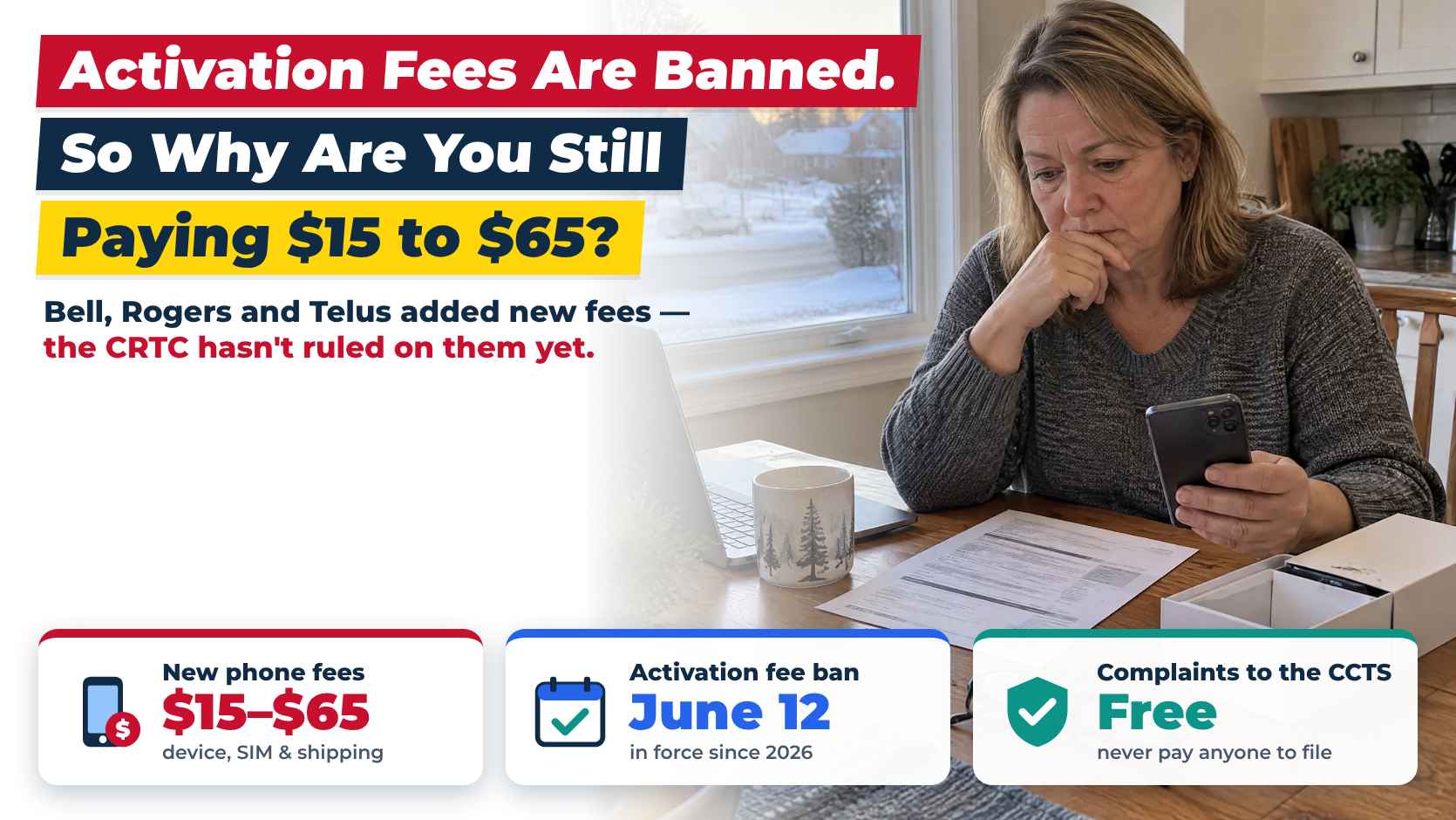
If you are planning to switch carriers or buy a new phone on a plan during the holiday sales, you were promised something in June: no more activation fees. That part is real. Since June 12, 2026, the CRTC’s rules bar wireless and home internet providers from charging you to activate, change or cancel a plan.
But within days, Canada’s three biggest carriers had new charges on the books — a $40 device fee at Bell, a $15 SIM fee at Telus, and $40 plus $25 shipping at Rogers. The CRTC says those charges may break the new rules. It has not decided yet.
So right now you can still be charged. Here is what the ban covers, what the regulator is questioning, and how to avoid paying more than you have to.
What the activation fee ban actually covers
The CRTC announced the change on March 12, 2026 in Telecom Regulatory Policy 2026-43. The amended Wireless Code and Internet Code took effect June 12.
What is banned: any fee for activating a new plan or modifying an existing one. That includes the old “connection” charge on a new line.
Who is protected: individual and small business customers of wireless service from any provider, and individual customers of home internet.
Cancellation: if your contract did not come with a subsidized phone, your provider can no longer charge an early cancellation fee. Before the change, the Wireless Code allowed up to $50 or 10% of your remaining monthly charges, whichever was less.
What is still allowed: two things. Reasonable fees for physically installing a service at your home, such as a technician setting up internet. And fees for “additional products or services the customer has explicitly chosen to purchase.”
That second exemption is where the fight is.
The new fees the CRTC is questioning
On June 30, the CRTC opened a formal show-cause proceeding, Telecom Notice of Consultation 2026-155. It names three sets of charges:
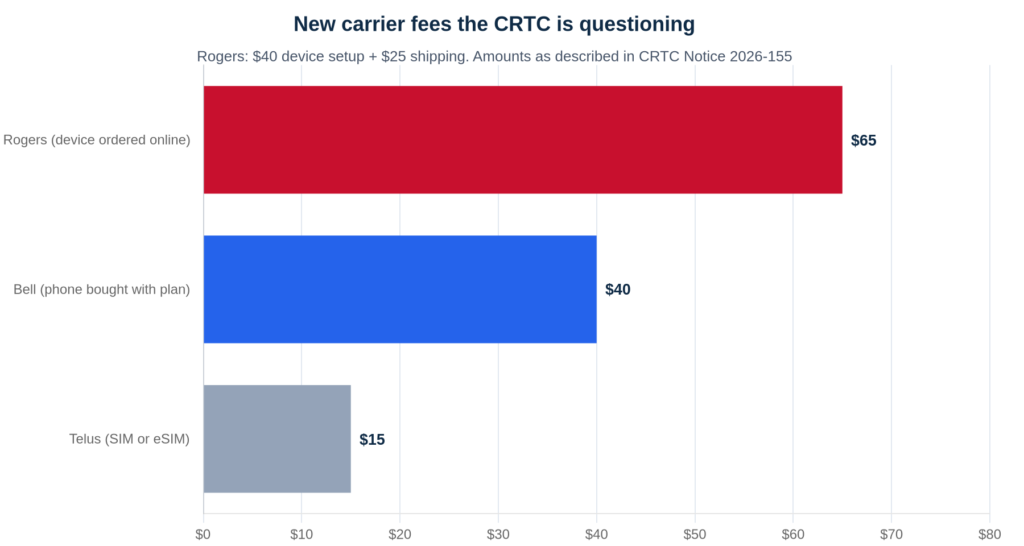
Bell: a $40 device-handling charge for customers buying a phone along with their wireless service.
Telus: a $15 fee for a SIM card or eSIM as part of its wireless service.
Rogers: a $40 device setup charge, a $25 shipping charge on devices ordered online, and a SIM fee with no amount stated. Rogers told the CRTC its SIM fee applies only when you ask to replace a lost or damaged physical SIM.
The legal question is whether these charges fit the exemption for products and services a customer explicitly chose to buy. The CRTC put the burden on the carriers: show why it should not find a violation. All three confirmed in June that they would keep charging while the case runs.
Why this matters to you
The mechanism is simple. A fee that used to be called “activation” is banned, so the same moment in the sale — getting the phone and SIM working on your new plan — gets a new name. If the CRTC accepts that, the ban saves you little. If it rejects it, the carriers can be ordered to stop.
It is the same pattern consumer class actions keep running into with drip pricing at DoorDash and service fees at Ticketmaster: the headline price is fine, and the cost moves into a line item you see at checkout.
Where the case stands
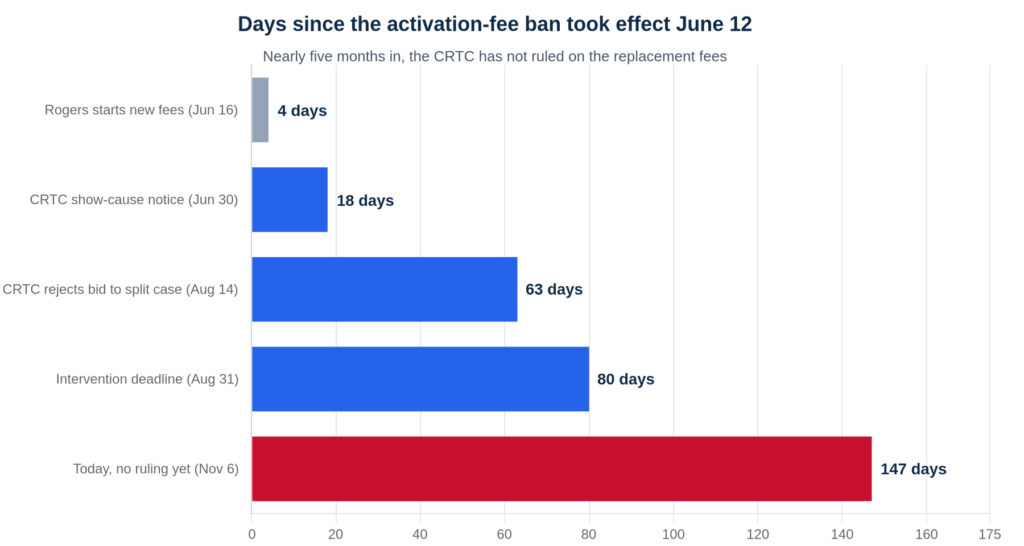
Slowly. Telus asked the CRTC in July to split the case and remove some staff from it; Bell and Rogers backed the request. The CRTC paused the schedule on July 29, then rejected those requests on August 14 and refused an oral hearing. Interventions were due August 31 and replies in early September.
As of November 6, we could find no final decision published by the CRTC.
What could happen
If the CRTC finds a violation, the notice sets out two tools. Penalties: up to $10 million per company, and up to $25,000 for responsible officers or directors. A compliance order: the carriers would have to stop charging the prohibited fees within 60 days of the order.
Notice what is missing. The CRTC’s notices say nothing about refunds to customers who already paid. A penalty goes to the government, not to you. Nobody knows yet whether past fees will ever come back, and be sceptical of any site or text message that says a refund is coming.
What to do this week
Ask for the full one-time cost in writing. Before you accept a holiday deal, ask the store or chat agent to list every one-time charge — device, SIM, shipping, setup. A screenshot of the chat is enough.
Pick up in store if shipping is the fee. Rogers’ $25 charge, as the CRTC describes it, applies to devices ordered online.
Bring your own phone if you can. Bell’s $40 charge, as the CRTC describes it, applies when you buy a phone along with your service. Ask whether a device fee applies if you keep the phone you have.
Check your last bill for a fee called activation or connection. If you were charged one after June 12, that is the fee the CRTC banned outright. Raise it with your provider first.
Escalate to the CCTS if they will not fix it. The Commission for Complaints for Telecom-television Services is free. You must give your provider a chance to resolve the problem first. The CCTS can require billing corrections and credits, and reimbursement of proven financial losses up to $5,000. It cannot fine anyone — that is the CRTC’s job.
Do not pay anyone to file a complaint or chase a refund. Complaints to your provider and to the CCTS cost nothing. There is no claim form and no settlement here. The same rule holds for every claim we cover, from the Scotiabank NSF fee settlement to the Government of Canada account breach settlement.
Ignore texts about a “CRTC fee refund.” Every rule change brings phishing that borrows the regulator’s name. No refund has been ordered, so a message promising one is fake. Our guide to spotting fake settlement messages covers the tells.
Also worth your time
- DoorDash Canada Hidden Fees Class Action: Drip Pricing Lawsuit Explained
- Ticketmaster Fees Settlement Canada 2026: Who Gets Paid
- Scotiabank $10.45M Settlement: Are You One of the 148,000?
- Settlement Scams in Canada: How to Spot a Fake
Fees, rules and proceeding status as of November 6, 2026, based on CRTC Telecom Regulatory Policy 2026-43 and Telecom Notices of Consultation 2026-155, 2026-155-1 and 2026-155-2. Carrier fees can change. This article is general information, not legal or financial advice. Confirm current charges with your provider and check crtc.gc.ca for any decision in the proceeding.

Tyler Bernick is a content writer covering Canadian settlement updates, scam alerts, and consumer rights. He aims to simplify complex legal topics and provide clear, reliable information to help Canadians make informed decisions.
Discover more from Settlement Alerts
Subscribe to get the latest posts sent to your email.