

If you bought a universal life insurance policy from a MetLife agent in Canada between 1987 and 1998, and Sun Life has been administering it since, a court has just approved a $213.5 million settlement that may owe you money. That includes people who cashed out or let the policy lapse years ago, and the estates of policyholders who have died.
Whether you have to do anything depends on one question: did you still hold the policy on March 31, 2026? If yes, your cash comes automatically by cheque. If no, you will have to send in an application, and there is no claim form or deadline yet.
That second group is the one at risk. Under the settlement, cash that nobody claims goes back to Sun Life. It is not handed to other claimants.
What the case was about
The case is Fehr et al. v. Sun Life Assurance Company of Canada in the Ontario Superior Court of Justice. It was filed in 2010. It covers three universal life products MetLife sold in Canada from 1987 to 1998: Universal Plus, Flexiplus and OptiMet. Sun Life took over administering them.
Universal life policies charge you a monthly cost of insurance, and often an administrative fee as well, both taken from your premiums. The plaintiffs alleged that Sun Life raised the cost of insurance rates and administrative fees on Flexiplus policies for reasons the contracts did not allow. They also alleged it charged some Universal Plus policyholders more than the “Maximum Premium” printed in their policy. Sun Life denies wrongdoing and admits no liability in settling.
Justice Leiper approved the settlement in reasons released September 23, 2026, after a hearing on September 8. Class counsel’s site gives October 8, 2026 as the date the settlement took effect.
Where the $213.5 million goes
The headline number is not a single pot of cash. According to the court’s reasons, it breaks down this way:
Cash benefits: up to $142.5 million, paid to eligible current and past Flexiplus and pre-1992 Universal Plus policyholders.
Future policy benefits: $71 million. That is the estimated value of a permanent freeze on current Flexiplus cost of insurance rates and administrative fees, plus a cap on future cost of insurance charges for current Universal Plus policies, set at 3.15 times the base Maximum Premium.
Legal fees and costs: the court approved class counsel fees of $63,337,472.66 plus HST, and $2,375,091.14 in disbursements. Fees and administration costs come out of the settlement value. The court also approved $25,000 honoraria for the representative plaintiffs.
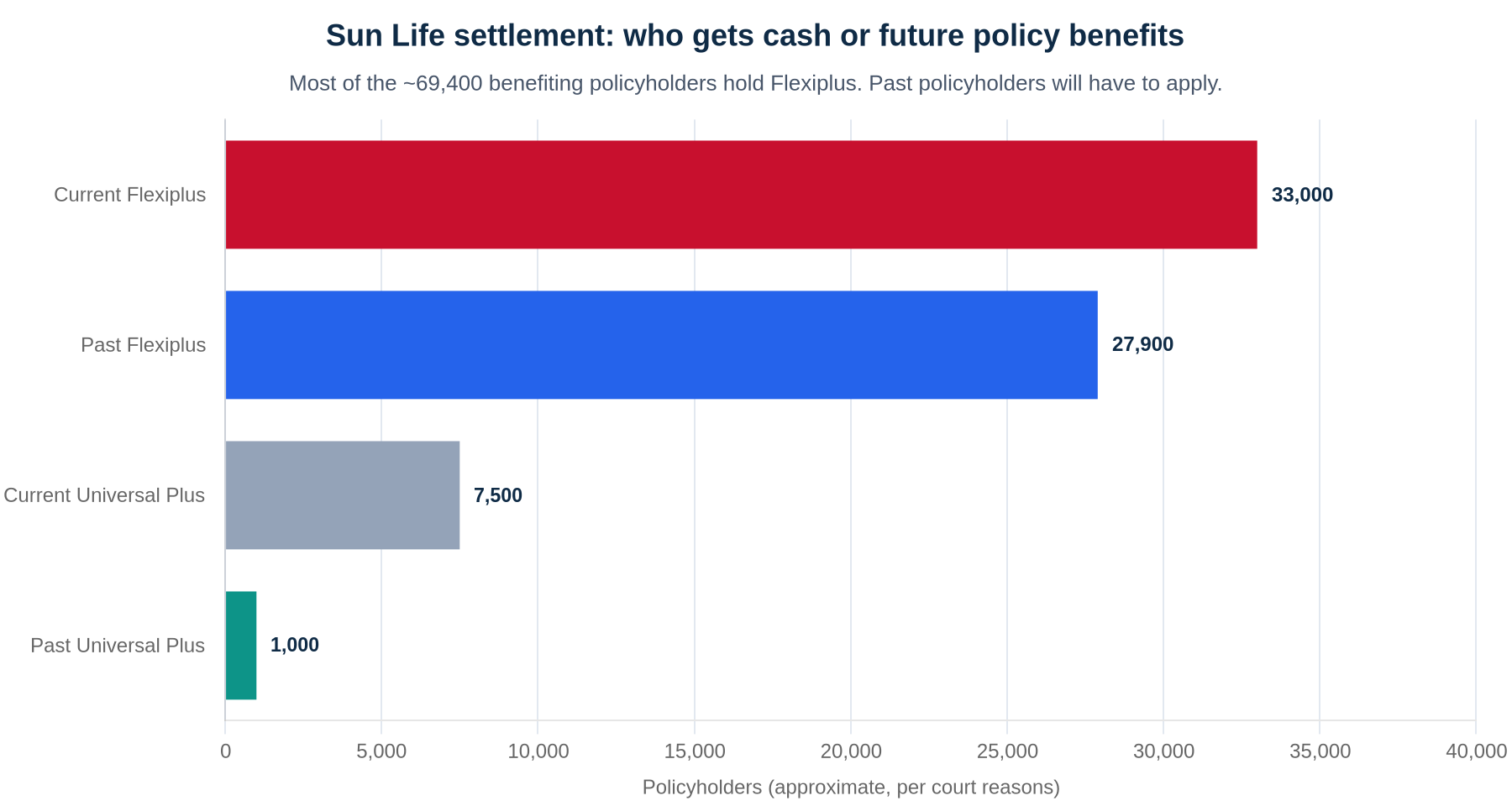
About 100,000 people are in the class. Roughly 69,400 will get cash, future policy benefits, or both. The rest are excluded, as explained below.
Who gets paid, and how
You still hold the policy
“Current” means you held the policy on the March 31, 2026 valuation date. Sun Life will use its own records to draw up lists of eligible policyholders. If you are on the list, your cash benefit arrives as a mailed cheque, with no application. If the cheque bounces back or is never cashed, Sun Life deposits the money into your policy’s accumulation fund instead. You can then use it to pay premiums or withdraw it under the policy terms.
Current Flexiplus holders also get the permanent rate freeze, even if they don’t qualify for cash. Current pre-1992 Universal Plus holders get the cap on future charges.
You surrendered it, it lapsed, or the policyholder has died
Past Flexiplus and Universal Plus policyholders, or their estate trustees, must submit an application to the claims administrator. If your name is on Sun Life’s list, you won’t need supporting documents. A claims administrator website will let you type in your details and see right away whether you are listed. Past Flexiplus holders whose policy lapsed or was surrendered after a cost of insurance increase may also get a supplementary payment.
Deadline: not set yet. The court’s reasons say the application deadline will be at least 12 months after the claims period begins. As of October 29, the claims administrator’s page has not been updated since before approval and shows no claims period dates.
If you think you qualify but aren’t on the list, there will be a Disputed Eligibility Claim Form. That route needs supporting documentation, such as your old policy papers and statements.
Who gets nothing
OptiMet holders (about 2,331 policies). The court found no evidence their rates were ever re-priced.
Later Universal Plus series from 1992, 1994 and 1998 (about 10,000 policies). Their wording defined Maximum Premium differently.
Prior releasors, including people in Sun Life’s Flexiplus Options Program who signed a release in exchange for compensation.
All three groups are still bound by the settlement, so they can’t sue separately over the same claims.
How much you might get
Nobody has published a per-person amount, and none exists. Sun Life will calculate each payment from your policy’s own history. What the court did publish is how much of the alleged overcharges the cash portion gives back.
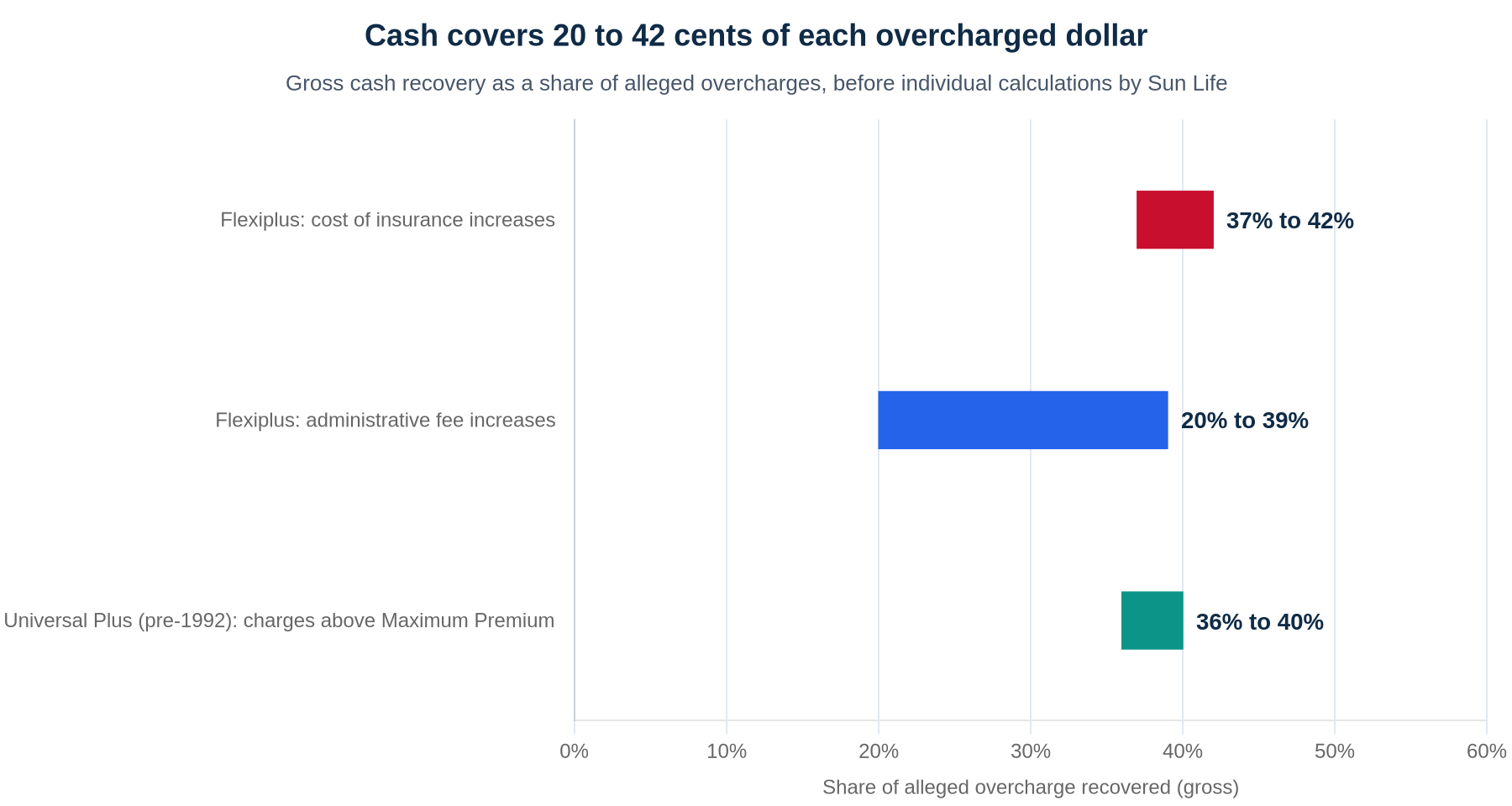
For Flexiplus, the gross recovery is 37% to 42% of the alleged cost of insurance overcharges and 20% to 39% of the alleged excess administrative fees. For pre-1992 Universal Plus, it is 36% to 40% of the charges paid above the Maximum Premium. Someone hit by several increases over 20 years could get a meaningful cheque. Someone with one small increase may get very little. Be sceptical of any site that quotes you a firm dollar figure. It can’t know.
Individual payments are calculated by Sun Life, not an independent actuary. Appeals are limited to whether you are eligible, not to the amount. That keeps administration costs down, but it means you can’t contest the number.
What to do this week
Work out whether you are current or past. If you still pay premiums on a Flexiplus or Universal Plus policy, you don’t need to file anything. Make sure Sun Life has your current mailing address, because the cheque comes by post.
If a parent or relative held one of these policies, find the paperwork now. Estates can claim, and many of these policies were bought 30 or more years ago as estate planning. Look for the policy contract, the product name, the policy number and the year of issue. The estate trustee is the one who applies.
Watch the official pages for the claims period. The class counsel site is sunlifeclassaction.com and the claims administrator is CA2 Inc. at classaction2.com/sunlife.html. You can email class counsel at SunLifeClassAction@complexlaw.ca. The administrator is at sunlife@classaction2.com or 1-800-538-0009. Class counsel says it is not taking phone calls for now.
Do not pay anyone to file for you. The process is free. Class counsel’s fees are already approved and come out of the settlement, not out of your pocket. If you get a letter or call offering to “recover your Sun Life overcharges” for a percentage, ignore it.
Expect phishing. News of a $213.5 million settlement aimed at older policyholders is exactly what scammers look for. Neither Sun Life nor the administrator will text you a link asking for your SIN, banking password or a “release fee.” We saw the same pattern after the Government of Canada account breach settlement opened. Our guide to settlement scams covers the warning signs. Type the official addresses in yourself.
Check your other financial-product claims while the files are out. If you also held mutual funds through a discount broker, the RBC trailing-commission settlement may apply. Investors in Wayland Group have until November 30 under the extended Wayland deadline.
More open settlements
- Two CIBC Mutual Fund Settlements Are Open at Once — Filing on the Wrong One Costs You Everything
- Canada’s $32.5 Billion Tobacco Settlement: One Claim Window Just Closed, the Other Runs to September 3, 2027
- In Care in Manitoba Between 2005 and 2019? The $445M CSA Settlement Closes January 5
- Waitlisted for Disability Services in Nova Scotia? The $34M Settlement Pays Up to $15,000 Base, Claims Close March 17, 2027
Figures and dates in this article are as of October 29, 2026. They come from the Ontario Superior Court’s reasons for decision in Fehr v. Sun Life Assurance Company of Canada, 2026 ONSC 5338 (released September 23, 2026, corrected September 29, 2026), the court-approved notice of settlement approval hearing, and the class counsel and claims administrator websites. This article is general information, not legal or financial advice. Settlement terms and deadlines can change. Always confirm details on the official settlement website or with class counsel, Kim Spencer McPhee Barristers P.C., before you act.

Tyler Bernick is a content writer covering Canadian settlement updates, scam alerts, and consumer rights. He aims to simplify complex legal topics and provide clear, reliable information to help Canadians make informed decisions.
Discover more from Settlement Alerts
Subscribe to get the latest posts sent to your email.