

If you bought Wayland Group or Maricann shares between late 2017 and mid-2019 and assumed that money was simply gone, there is an $8 million settlement you may still be able to claim from. The deadline that was printed everywhere — September 30, 2026 — has been pushed back. You now have until November 30, 2026.
That is the second extension. The original deadline was August 20. The administrator announced the new date on September 29, one day before the old one would have shut the door.
Before you log in to your old brokerage account, understand what this is worth. The recovery is measured in cents per share, it is pro rata, and anything under $100 is not paid at all. For a lot of small investors, that last rule decides everything.
What the case is about
Maricann Group was an Ontario cannabis producer that renamed itself Wayland Group. Three investor class actions in the Ontario Superior Court of Justice alleged that, between December 13, 2017 and August 2, 2019, the company and others made misrepresentations about its business, finances and in particular the build-out of its production facility in Langton, Ontario.
Those are allegations. The settling defendants — Wayland, five individual defendants, and the investment dealers Canaccord Genuity and GMP Securities (now RF Securities Clearing) — deny them, and no court has found wrongdoing. Former CEO Benjamin Ward is not part of the settlement; the case against him continues separately.
The mechanism matters here. Wayland filed for creditor protection under the CCAA in December 2019. A company in that position has little money to pay anyone. What investors could realistically reach was insurance — and the court’s approval decision says class counsel weighed the defendants’ finances, the insurance policies and the statutory limits on damages before agreeing to $8 million. That is why the number is small relative to the losses. It was negotiated against what was collectable, not against what was lost.
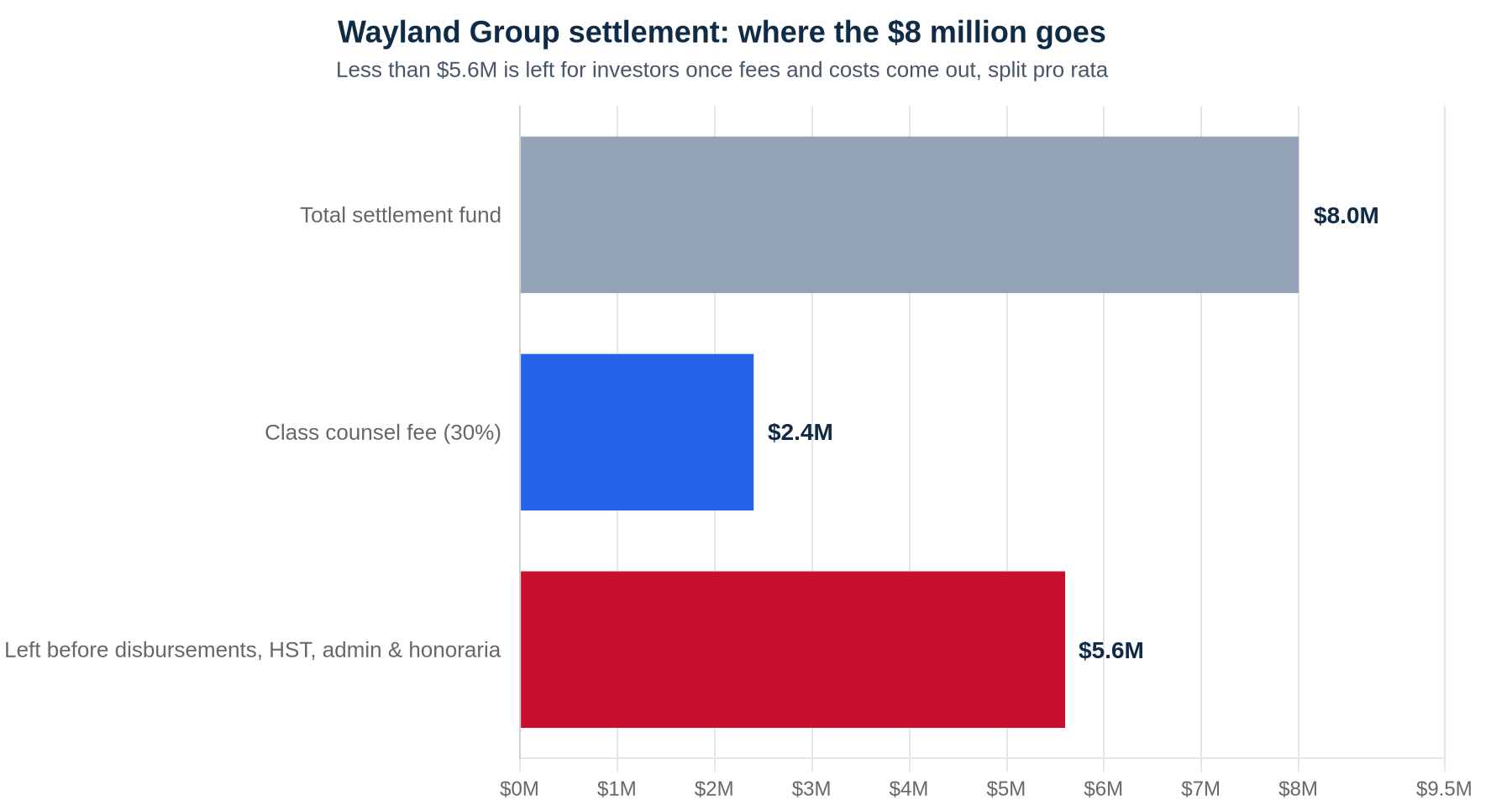
Justice Morgan approved the settlement on March 19, 2026, including class counsel fees of $2.4 million (30%) plus disbursements and HST, and $5,000 honoraria for each of the four representative plaintiffs.
Who is covered
The class: anyone, wherever they live, who purchased or otherwise acquired common shares, units or warrants of Wayland Group Corp. or Maricann Group Corp. on or after December 13, 2017 and held some or all of them as of the close of trading on August 2, 2019. Defendants, their families and anyone who opted out are excluded.
Claim deadline: November 30, 2026.
Where to file: online through the Nuvo Claims system at nuvoclaims.com/our-settlements/wayland-group. The settlement administrator is Berger Montague (Canada) PC, which is also class counsel. Its case page is at bergermontague.com/cases/wayland-group-corp.
A warning about the date: as of October 5, both of those pages still show September 30 as the deadline. The November 30 extension comes from a notice Berger Montague issued on September 29. If the old date on the website makes you hesitate, call the administrator at 647-576-7840 or email info@bergermontague.ca and confirm before you assume you have missed it.
What you can actually get
The plan of allocation sorts your shares into buckets by when you bought and when you sold. Each bucket has a maximum recovery per share. The court amended these caps on April 28, 2026 to clear up confusing wording, and the amended version is what applies.
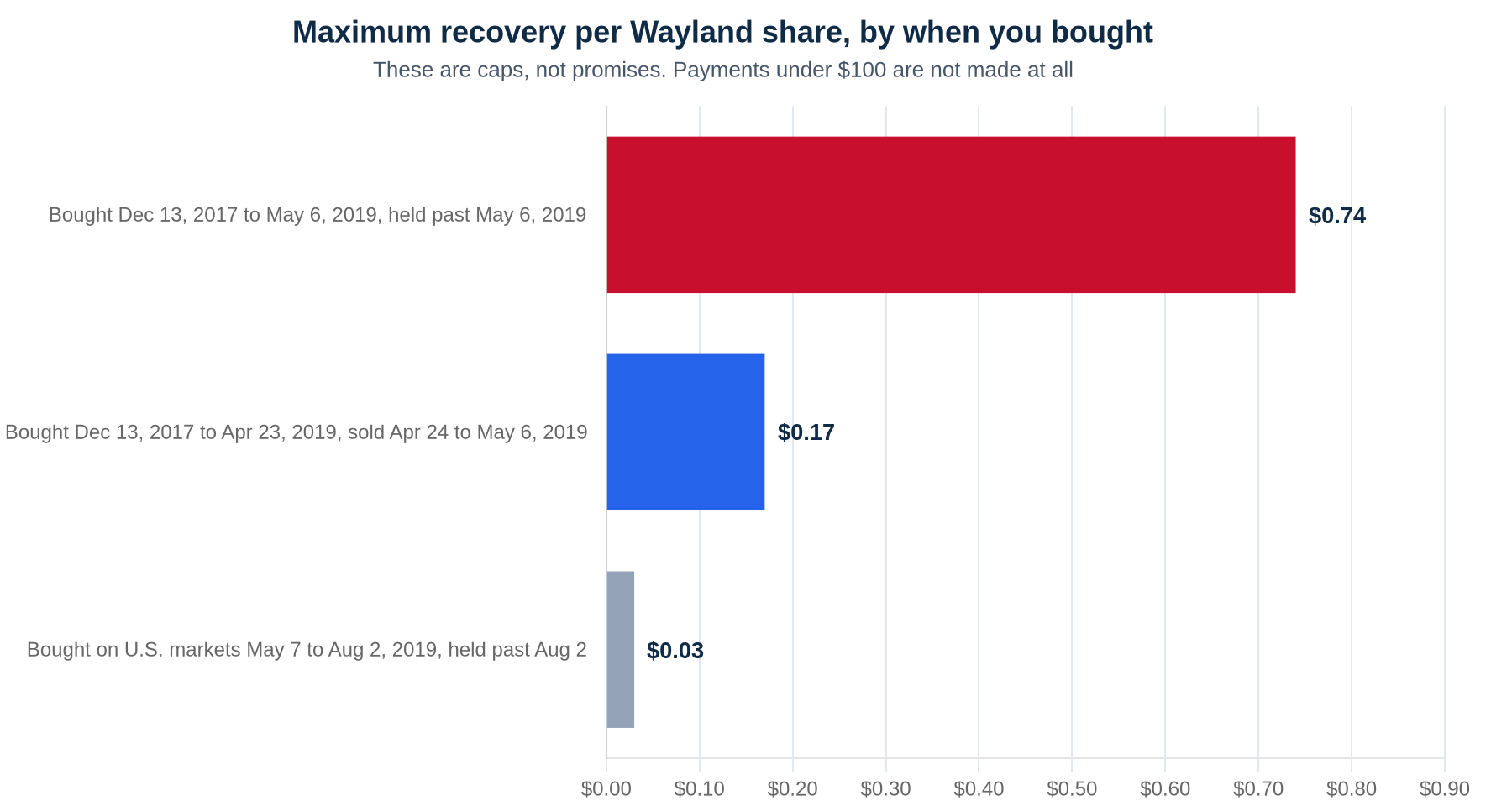
Up to $0.74 a share if you bought between December 13, 2017 and May 6, 2019 and still held after May 6, 2019. This is the main group.
Up to $0.17 a share if you bought between December 13, 2017 and April 23, 2019 and sold between April 24 and May 6, 2019.
Up to $0.03 a share if you bought on U.S. markets between May 7 and August 2, 2019 and held past August 2. The court’s endorsement explains why it is so low: by then the stock was trading around $0.24 on U.S. over-the-counter markets, and the final corrective disclosure on August 2 knocked it to $0.21. The drop was three cents.
These are ceilings, not promises. The net fund is split pro rata across every valid claim, so if claimed losses exceed what is left after fees and costs, everyone is scaled down. Nobody knows the final per-share figure yet, and be sceptical of any site that gives you one. It cannot be calculated until the claim window closes and every claim is checked.
The $100 floor
The plan of allocation says no payment will be made for any amount under $100. Do the arithmetic before you spend an evening on paperwork. Even at the full $0.74 cap, you would need roughly 136 qualifying shares to reach $100. If payments are scaled down, you need more. At $0.03 a share, you would need more than 3,300 shares.
If you held a few thousand shares through May 2019, filing is plainly worth it. If you held 50, it almost certainly is not — though it still costs you nothing but time.
The cheque has a 45-day clock
Payments go out by e-transfer, bank transfer or cheque. If you do not deposit the cheque or accept the transfer within 45 days, you forfeit it, the money is redistributed to other claimants, and cheques are not reissued. Keep your contact details current with the administrator. Unclaimed money is the same trap we flagged on the CIBC mutual fund settlements.
What to do this week
Find your trade history first. The claim needs supporting documentation — brokerage statements or other proof acceptable to the administrator showing what you bought during the class period and what you still held. Statements from 2018 and 2019 may be archived, and if you have changed brokers since, the old one may take weeks to send them. That is the real reason not to wait until November.
Work out your bucket and your rough number. Count your shares by purchase date and sale date, multiply by the cap that applies, and see whether you clear $100 even before any scaling. If the plan’s wording does not fit your trades neatly, file anyway and let the administrator decide. It is free to ask.
Do not pay anyone to file for you. The claim process is free. Class counsel’s fees are already approved and come out of the fund, not your pocket. Anyone charging an upfront fee to “recover your Wayland losses” is not part of this case.
Watch for phishing that rides the news. Deadline extensions get reported widely, and scammers follow. The administrator will not text you asking for your SIN or online banking password to “release” a payment. We saw the same pattern after the Government of Canada account breach settlement opened. Type the Nuvo or Berger Montague address in yourself rather than tapping a link someone sent you.
Check your other investor claims while you have statements out. If you held mutual funds at a discount brokerage, the RBC trailing-commission settlement and the CIBC deadline of October 21 may also apply to you.
More open settlements
- Two CIBC Mutual Fund Settlements Are Open at Once — Filing on the Wrong One Costs You Everything
- RBC’s $45M Mutual Fund Settlement Has No Claim Form Yet — but a CIBC Deadline Is October 21
- Truffettes de France Settlement Pays $3 a Box, Up to $9 Without a Receipt — Claims Close November 4
- exo Train-Delay Settlement Pays Up to $145 — and Claims Close October 20
Figures and dates in this article are as of October 5, 2026, taken from the Ontario Superior Court’s March 19, 2026 approval decision, the April 28, 2026 supplementary endorsement, the court-approved plan of allocation and the administrator’s September 29, 2026 deadline notice. This article is general information, not legal or financial advice. Settlement terms and deadlines can change. Always confirm details on the official settlement website or with class counsel, Berger Montague (Canada) PC, before filing.

Tyler Bernick is a content writer covering Canadian settlement updates, scam alerts, and consumer rights. He aims to simplify complex legal topics and provide clear, reliable information to help Canadians make informed decisions.
Discover more from Settlement Alerts
Subscribe to get the latest posts sent to your email.