
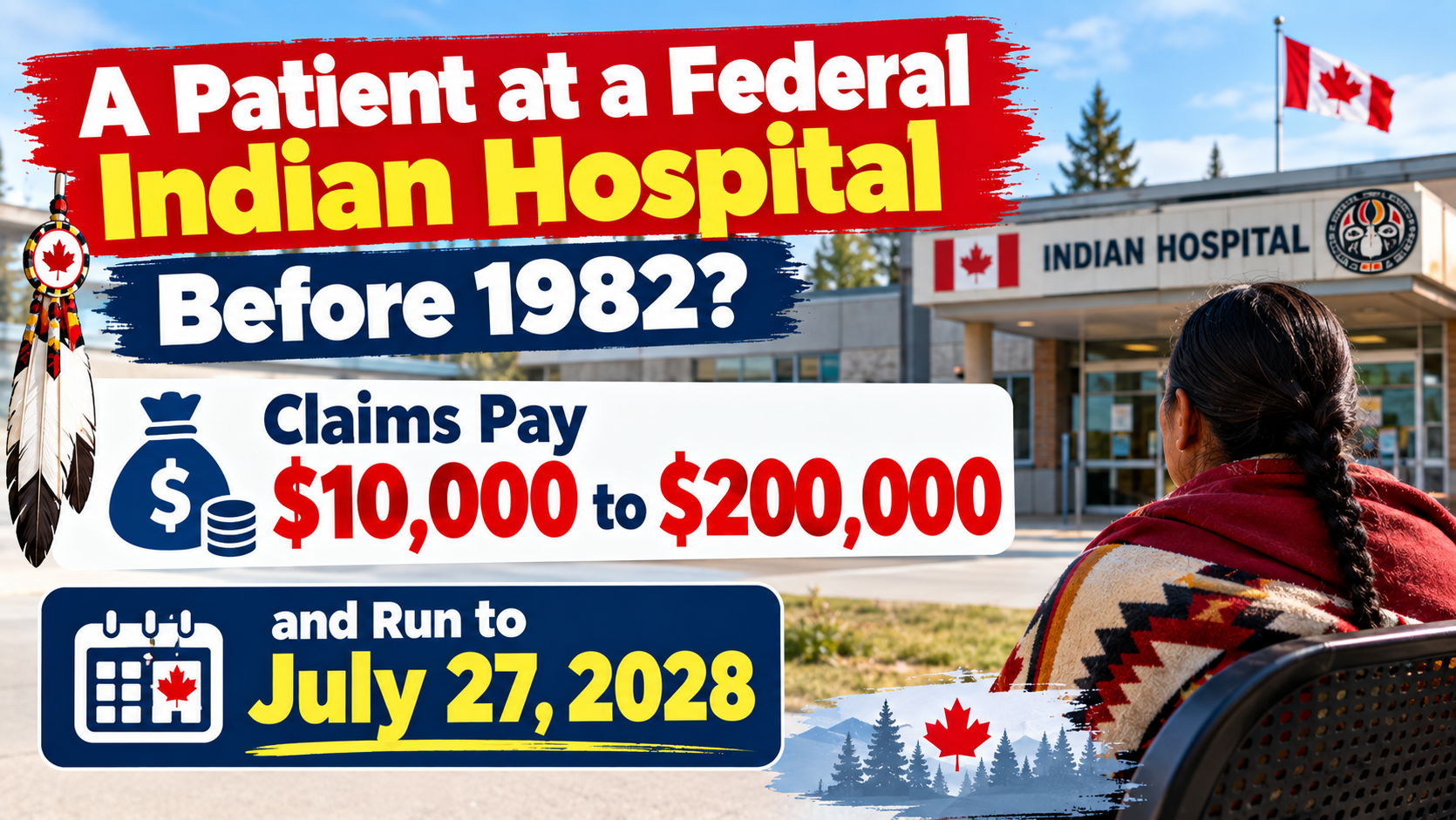
If you, a parent or a grandparent spent time as a patient in one of Canada’s federal Indian hospitals, there is a claim open right now that pays between $10,000 and $200,000. It has been open since January 27, 2026, and it runs until July 27, 2028.
That deadline is a long way off. That is exactly the problem. Long claim windows get put off, and the people this settlement covers were admitted between 1936 and 1981. Many are now elderly. A claim filed while the person is still living is far simpler than one an estate has to piece together later.
Here is what the settlement pays, who qualifies, and the one cut-off date that decides whether a family can claim at all.
What the settlement covers
From 1936 to 1981, the federal government ran a network of hospitals for First Nations and Inuit patients. The settlement lists 33 of them, from the Charles Camsell Indian Hospital to Moose Factory, Sioux Lookout, Fort Qu’Appelle, Nanaimo and Inuvik. Each hospital has its own covered dates, set out in a schedule on the official site.
The class action alleged that patients suffered abuse while admitted. The Federal Court approved the settlement on June 24, 2025. It pays compensation for abuse — psychological, verbal, physical or sexual — that happened while a person was admitted to one of those hospitals.
One limit matters. The settlement does not cover claims about medical treatment itself. It covers what happened to patients outside of treatment, not the quality or nature of the care.
Deadline: July 27, 2028.
Where to file: the official site is ihsettlement.ca, with claims submitted through its portal. Deloitte LLP is the court-appointed claims administrator. Class counsel are Koskie Minsky LLP, Cooper Regel, Klein Lawyers LLP and Merchant Law Group LLP. Nothing else is official.
What it pays, and why the amounts are firm
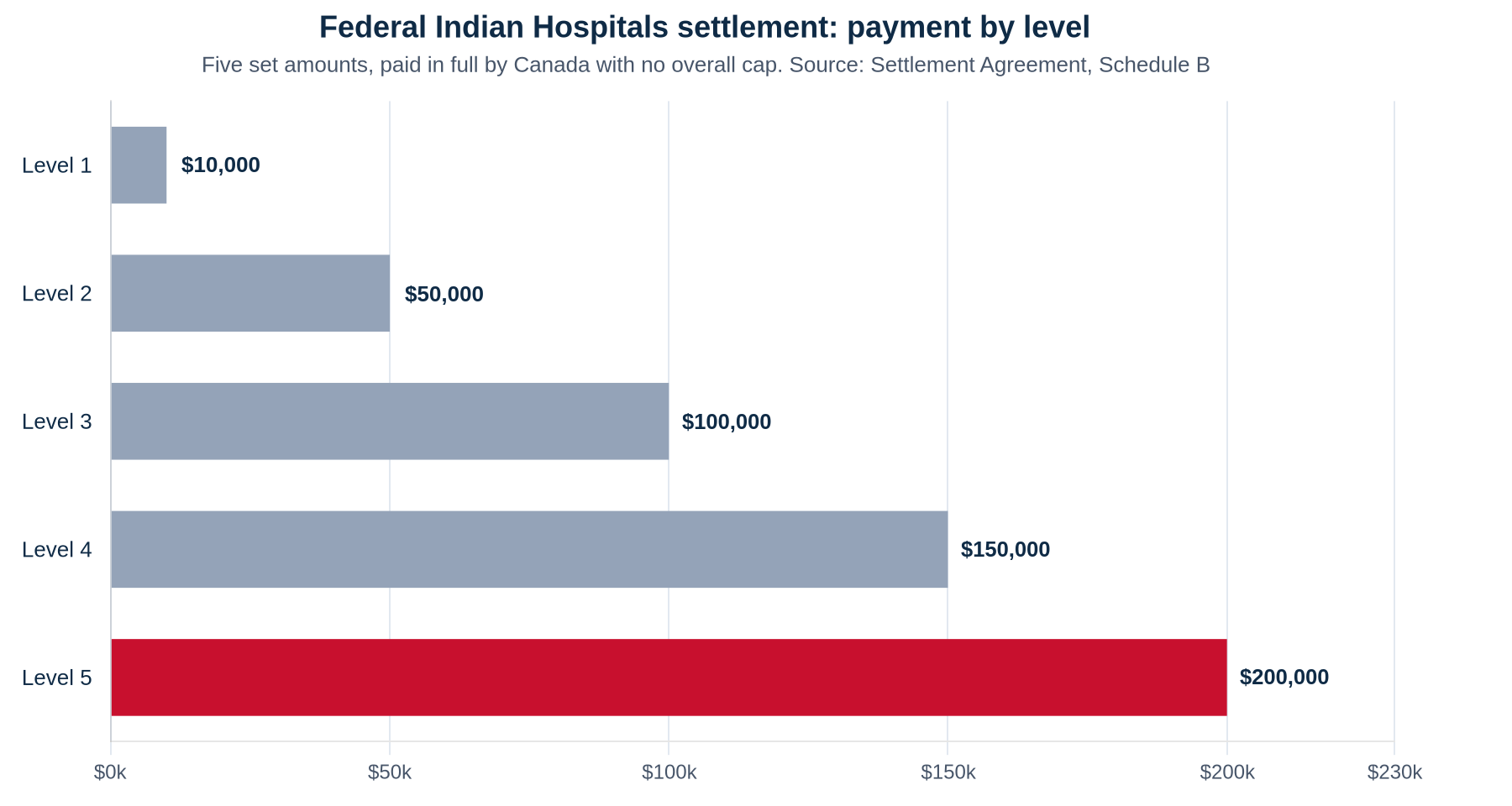
Compensation is set by a grid with five levels. The claims administrator places each approved claim at one level, based on what happened.
Level 1 — $10,000: sexual comments, unreasonable or disproportionate discipline, mocking or humiliation, threats, or confinement unrelated to medical treatment.
Level 2 — $50,000: unwanted sexual touching or exposure, or physical assault causing injury that was not permanent.
Levels 3 to 5 — $100,000, $150,000 and $200,000: more serious and repeated sexual abuse, and physical assaults causing long-term or permanent harm. The full definitions are in Schedule B of the settlement agreement.
Here is the part that makes this settlement different from most we cover. The agreement says there is “no limit or cap on Canada’s total obligation to pay compensation to Approved Claimants.” Canada pays every approved claim in full.
Most settlements work the other way. A fixed pot gets divided among everyone who files, so nobody knows the per-person amount until the window closes. Here, the grid amount is the amount. A Level 2 claim pays $50,000 whether 500 people file or 50,000. Your claim does not shrink because someone else filed.
The agreement also describes the compensation as non-pecuniary damages, “not referable to income.” If you receive income-tested benefits and are unsure how a payment would interact with them, ask the administrator or a Claims Helper before you assume anything.
Who can claim — and the January 25, 2016 cut-off
Primary class members: anyone who was admitted to one of the 33 listed hospitals while the federal government operated it. Family members are part of the class too, but only the person who was admitted receives individual compensation.
No records needed to start: the official site says you do not need medical records or hospital documents to submit a claim. That matters, because many of these hospitals closed decades ago.
The estate rule: this is the date families most need to know. A claim can be paid only if the person who was admitted was alive on January 25, 2016. If they died on or after that date, their estate representative can file and receive the full amount they would have been paid. If they died before January 25, 2016, the agreement says no payment is available.
That is why waiting is risky. If a parent qualifies and is still living, filing now means they can tell their own story. If they pass away mid-claim, the estate representative has to notify the administrator before the claim can continue.
This is one of several institutional settlements running at once. If your family was also affected by child welfare practices, the Manitoba Children’s Special Allowance settlement and the B.C. birth alerts settlement have their own, much earlier deadlines.
What else the settlement pays for
Individual compensation is only one part of the deal. The settlement also sets aside money for healing, research and commemoration, none of which comes out of individual payments.
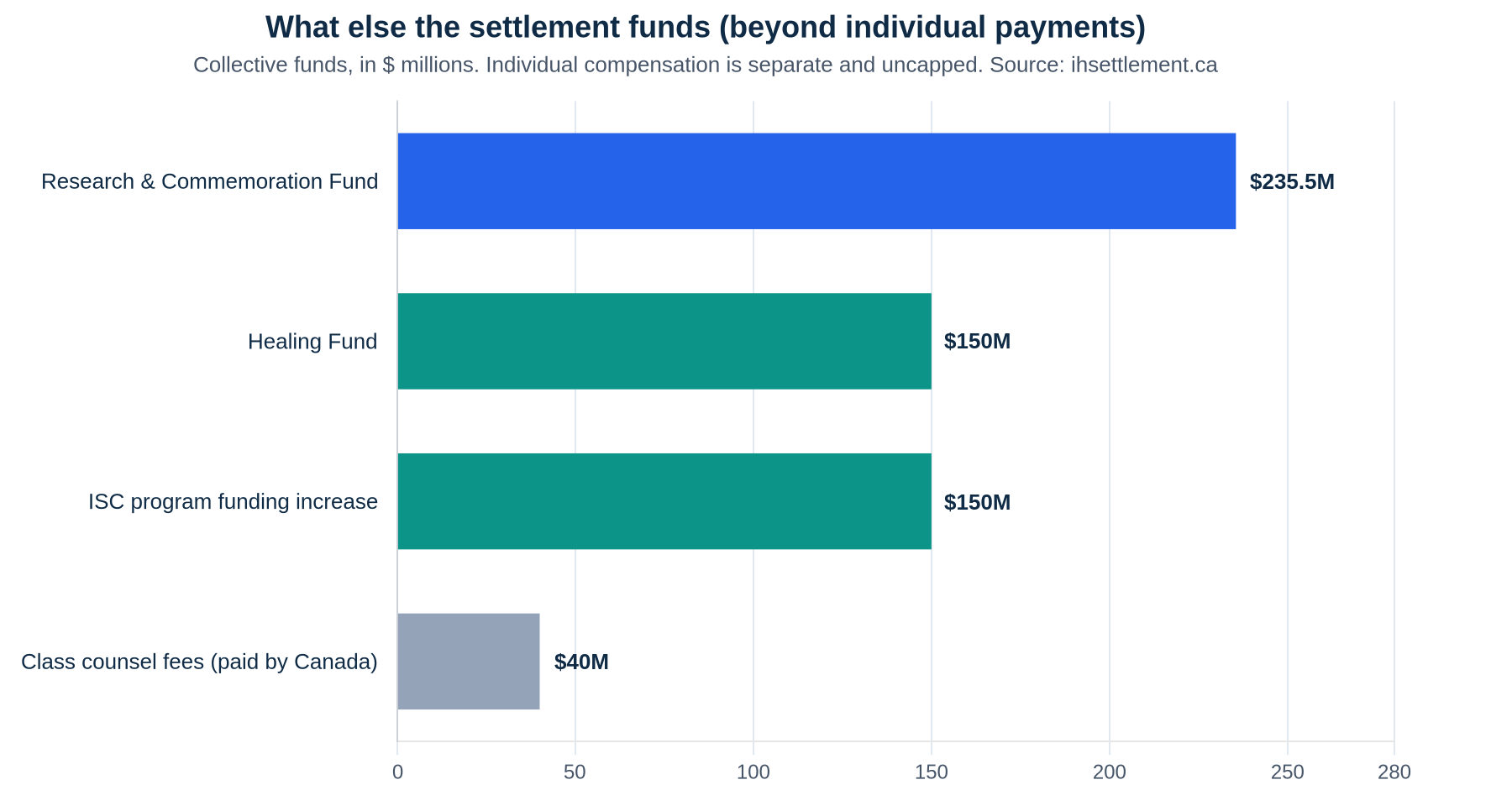
Healing Fund: $150 million. Research and Commemoration Fund: $235.5 million. Indigenous Services Canada programs: a $150 million funding increase to existing programs.
Lawyers’ fees: class counsel’s $40 million, plus tax and disbursements, is paid directly by Canada. If you hire your own lawyer, Canada pays that lawyer up to 5% of your award on top of it. That fee is not deducted from your compensation.
How long payment takes
The official FAQ is honest that it varies. Payment starts only after a claim is fully reviewed and a compensation level is decided. Nobody can give you a firm timeline, and be sceptical of anyone who promises one.
If your claim is denied, or placed at a lower level than you applied for, you can ask for reconsideration. An Independent Reviewer outside the administrator’s office looks at it again. And if extraordinary circumstances stop you from meeting the deadline, the agreement allows written requests for an extension — but only up to 180 days after July 27, 2028. Do not plan around that.
What to do this week
Ask the elders in your family. Many people never talked about their time in these hospitals. A conversation now may be the only way to learn whether someone qualifies — and the claim is stronger in their own words.
Check the hospital and the dates. Open the hospital list on ihsettlement.ca and match the hospital to the years it was federally run. Coverage is hospital by hospital.
Use a free Claims Helper. The official site offers free help filling in the form, plus webinars. Indigenous Services Canada also provides cultural and emotional support. If talking about this brings things up, the Hope for Wellness Helpline is free and confidential at 1-855-242-3310, in English, French, Cree, Ojibway and Inuktitut.
Do not pay anyone to file. The official FAQ says it plainly: “You do not have to pay anyone to submit a Claim or to receive compensation.” If you want a lawyer, Canada pays their fee, capped by the agreement. Anyone asking you for money upfront, or for a share of your award, is not following this settlement’s rules.
Watch for scams. Large settlements draw phishing calls, texts and emails offering to “speed up” a payment or asking you to confirm banking details through a link. Type ihsettlement.ca into your browser yourself. We saw the same pattern after the Government of Canada account breach settlement opened, and it will follow this one too.
More open settlements
- In Care in Manitoba Between 2005 and 2019? The $445M CSA Settlement Closes January 5
- Waitlisted for Disability Services in Nova Scotia? Claims Close March 17, 2027
- Held in Segregation in a B.C. Jail? The $60M Settlement Closes January 11
- Canada’s $32.5 Billion Tobacco Settlement: The Claim Window That Runs to September 3, 2027
Figures and dates in this article are as of October 4, 2026, taken from the settlement agreement and the official settlement website, ihsettlement.ca. This article is general information, not legal or financial advice. Settlement terms, deadlines and eligibility rules can change. Always confirm details on the official settlement website, with the claims administrator, or with class counsel before filing.

Tyler Bernick is a content writer covering Canadian settlement updates, scam alerts, and consumer rights. He aims to simplify complex legal topics and provide clear, reliable information to help Canadians make informed decisions.
Discover more from Settlement Alerts
Subscribe to get the latest posts sent to your email.