
If you have ever bought a mutual fund inside a self-directed trading account — RBC Direct Investing, CIBC Investor’s Edge, TD Direct Investing — you have probably seen a headline saying RBC will pay $45 million and you might be owed money. Here is the part the headlines leave out: there is no RBC claim form. There is nothing for you to file today, and no deadline to miss.
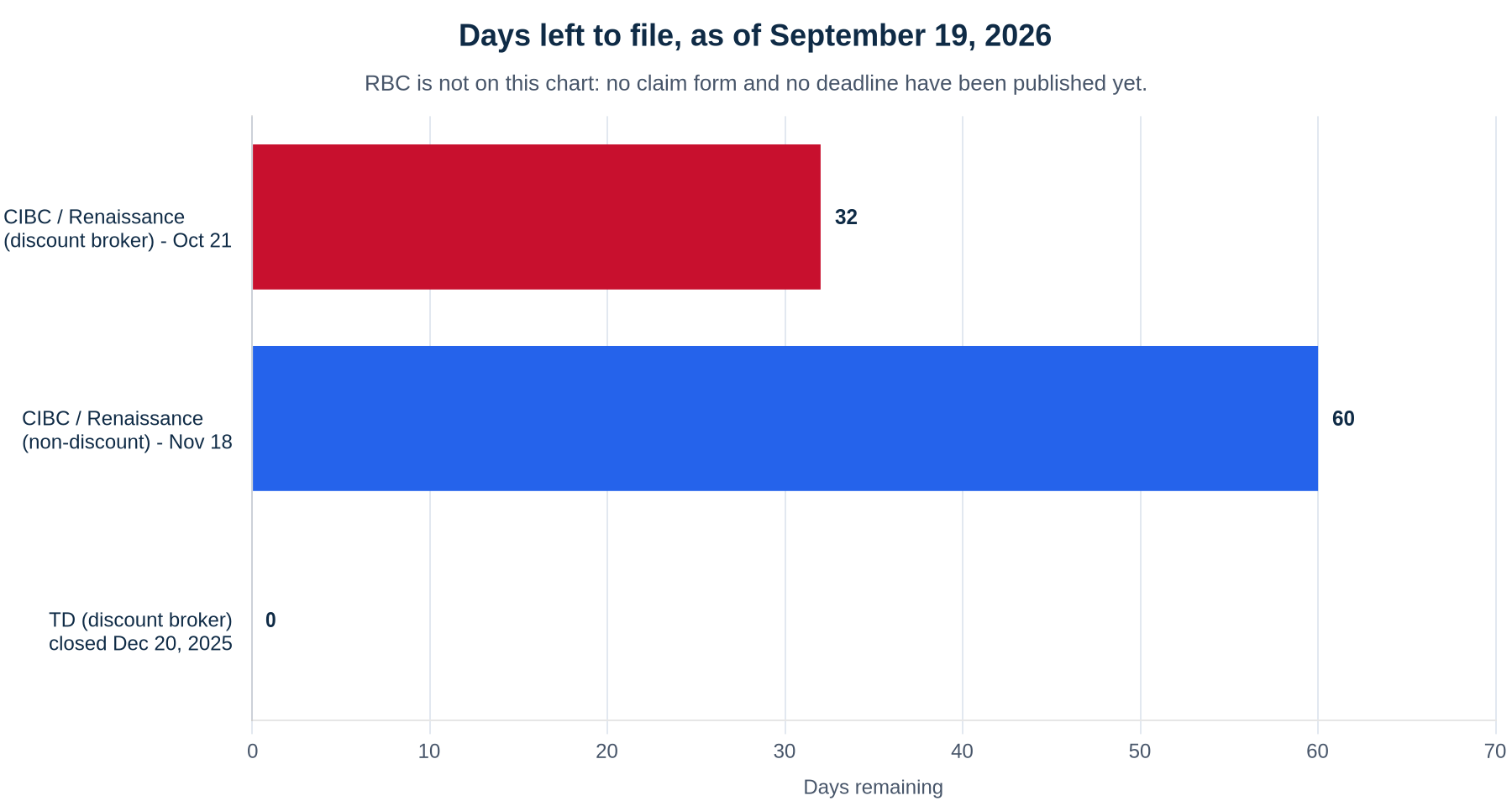
There is something you can file right now, though, and it closes soon. The CIBC and Renaissance discount-broker settlement stops accepting claims on October 21, 2026. That is about a month away, and it is a separate settlement from the CIBC one that closes in November.
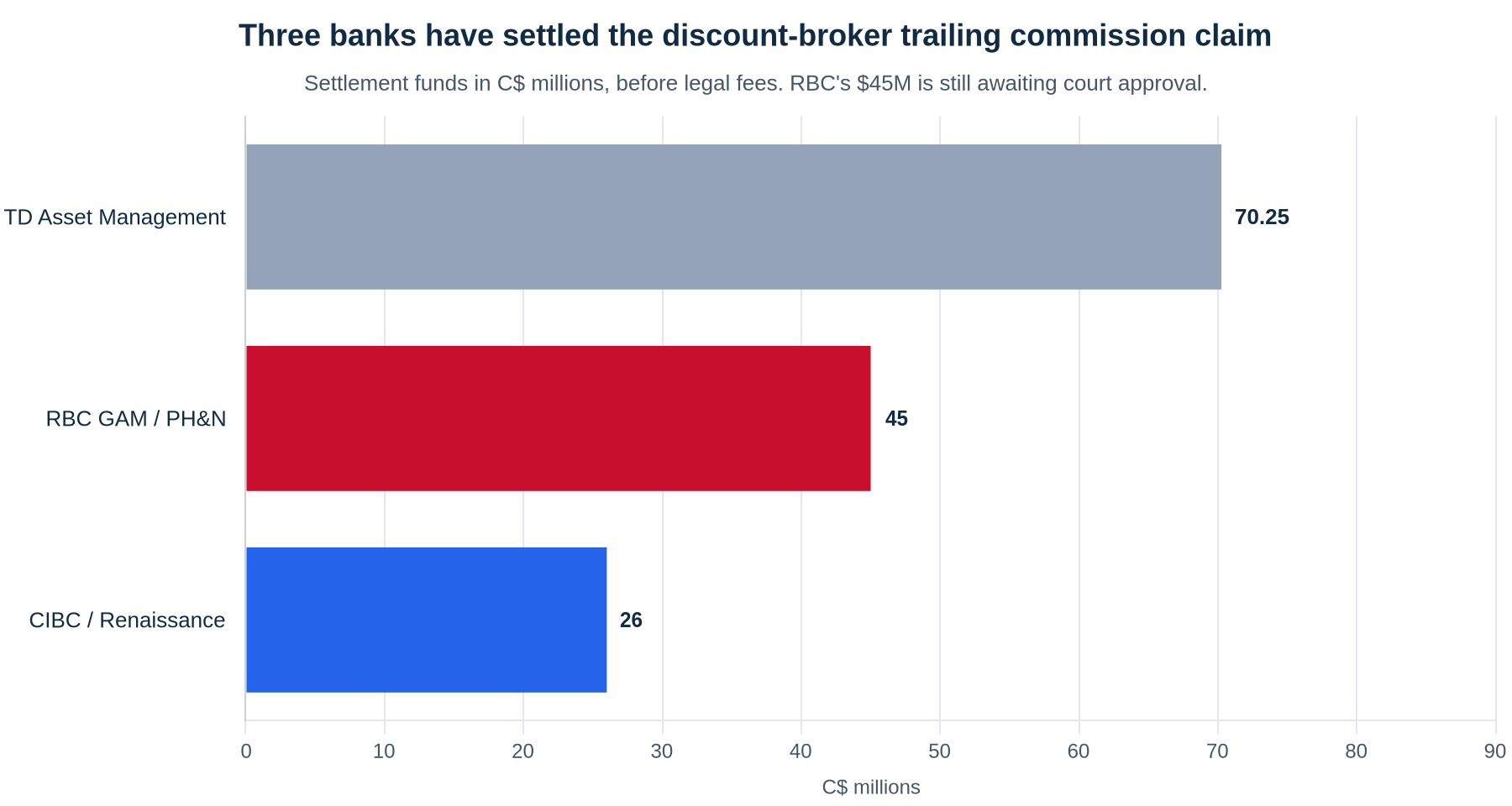
These are not unrelated cases. Four of Canada’s big banks have been sued over the same practice, three have now agreed to pay, and each is at a different stage. One window has already shut for good. Here is where each one actually stands.
What the banks are accused of doing
The mechanism is worth understanding, because it explains who is eligible and who is not.
When you buy a mutual fund, the company running the fund pays an ongoing cut — a trailing commission, or “trailer fee” — to the dealer that sold it to you. That money is meant to pay for advice: someone reviewing your holdings, answering your calls, telling you when to rebalance.
Discount brokers do not give advice. They are not permitted to. You click, you buy, you are on your own. The class actions allege that the fund companies kept paying trailing commissions to discount brokers anyway, and that the cost came out of the funds’ own assets — meaning it came out of the returns of the people holding the units.
That is why every one of these settlements turns on the same question: did you hold the fund through a discount broker, or through an advisor? Get that backwards and you will file on the wrong settlement, which is a mistake we have written about before in CIBC’s case.
The one you can still claim: CIBC and Renaissance, October 21
Deadline: October 21, 2026. The official settlement site calls this the Claims Bar Deadline, and claims are open now.
Who is covered: people who held units of a CIBC Mutual Fund or a Renaissance Mutual Fund through a discount broker between September 18, 2003 and January 25, 2024.
Settlement fund: C$26 million, according to class counsel at Siskinds LLP. The court approved it on November 5, 2025.
Administrator: Verita, through its claims portal. Start at the official settlement website — cibc-eng.trailingcommissionssettlement.ca — rather than from a link someone sent you.
What it pays: nobody knows. This is a pro-rata settlement, which means the money left after legal fees gets divided among approved claimants. Until the administrator knows how many valid claims came in, no per-person figure exists. If a website gives you a firm dollar amount for this settlement, that website made it up.
The other CIBC settlement is not this one
CIBC settled twice. The second case covers people who held CIBC or Renaissance funds outside a discount broker — through an advisor — for C$11 million, and its deadline is November 18, 2026. Two open claims, two different eligibility rules, two different websites. If you had both kinds of account over the years, you may qualify for both.
RBC: $45 million, and nothing to file
RBC Global Asset Management agreed to pay C$45 million to settle the same allegation. The class covers anyone who held units of an RBC Mutual Fund or a PH&N Mutual Fund through a discount broker between December 28, 2003 and July 25, 2024.
That is a large class and a real number. Here is what is not settled:
Approval: the settlement went before the Ontario Superior Court of Justice on September 8, 2026. As of publication we could not find a published approval order, and class counsel’s own case page still lists the settlement as pending approval. Until a court signs off, this is an agreement, not a payout.
Claims: no claim form exists and no claim deadline has been set. The objection deadline for class members who wanted to oppose the deal was August 18, 2026, and it has passed. The distribution protocol — the document that will explain how money actually reaches people — is the thing to watch for next.
Per-person amount: unknown, and be sceptical of any site that gives you a firm number. The official notice caps class counsel fees at C$12.6 million plus expenses and taxes, so the pool that reaches investors is smaller than $45 million. Divided among how many people, over a class period of more than twenty years? Nobody has published that figure, because nobody has calculated it yet.
There is one more wrinkle worth knowing. In some of these mutual fund settlements, people who still hold the fund get compensated inside the fund automatically, and only former unitholders have to file anything. Whether RBC’s distribution works that way has not been confirmed. Do not assume either way until the protocol is posted.
TD’s window already closed — and it was the biggest one
TD Asset Management settled the discount-broker claim for C$70.25 million, the largest of the three. The claims deadline was December 20, 2025. It has passed. There is no late filing, no appeal to the administrator, nothing.
This is the single most expensive mistake in this space, and it is worth being blunt about it: aggregator sites routinely leave closed claims sitting on their “open settlements” lists for months. We keep a running list of what is actually open and what has quietly shut for exactly this reason. Check a date on the administrator’s own website before you spend an evening gathering account statements.
Four other banks have settled nothing
Class actions over trailing commissions have also been certified against BMO Investments (certified May 18, 2021), National Bank Investments and Natcan Trust (August 5, 2022), 1832 Asset Management, which manages Scotiabank’s funds (December 18, 2023), and Mackenzie Financial (January 25, 2024).
Certification is not settlement. It means a court agreed the case can proceed as a class action. There is no money, no claim form and nothing to do about these four right now. If you held BMO or Scotiabank funds in a self-directed account, the honest answer is: wait. Note that Scotiabank’s other, unrelated $10.45 million settlement is a different matter entirely.
What to do this week
Work out which kind of account you had. Dig out an old statement. If the header says Direct Investing, Investor’s Edge or another self-directed platform, you were with a discount broker. If an advisor’s name is on it, you were not. This one detail decides everything.
File the CIBC discount-broker claim before October 21 if you held CIBC or Renaissance funds that way at any point since 2003. You do not need to remember exact amounts to start — begin at the official settlement site and let the administrator match your records.
Check the November 18 CIBC deadline too if you also held those funds through an advisor. They are separate claims and filing one does not file the other.
Register for updates on RBC and then forget about it. The settlement website lets class members sign up for notification. That is genuinely all you can do until the distribution protocol appears.
Do not pay anyone to file a claim for you. Every one of these claim processes is free. There is no filing fee, no processing fee and no service that can move you up a queue. Companies that charge a percentage of your settlement money for filling in a form are taking a cut of money that is already yours.
Treat every text and email about this as a scam until proven otherwise. Settlement news reliably produces a wave of phishing. A real claims administrator will not text you a link, will not ask for your SIN by email, and will never ask for banking passwords or a fee to release your payment. When in doubt, close the message and type the official settlement address into your browser yourself. The same pattern follows every breach settlement we cover.
More open settlements
- Two CIBC mutual fund settlements are open at once — which one applies to you
- The Silk and Great Value recall settlement, open until October 16
- Two CAF class actions, one already closed — the racism claim deadline is October 15
- Capital One’s $35M Canadian data breach settlement
Figures and deadlines are as of September 19, 2026, and settlement terms can change when a court rules. This is general information, not legal or financial advice. Confirm your own eligibility and any deadline on the official settlement website or with class counsel before you file, and never rely on a third-party summary — including this one — for the final word.

Tyler Bernick is a content writer covering Canadian settlement updates, scam alerts, and consumer rights. He aims to simplify complex legal topics and provide clear, reliable information to help Canadians make informed decisions.
Discover more from Settlement Alerts
Subscribe to get the latest posts sent to your email.