
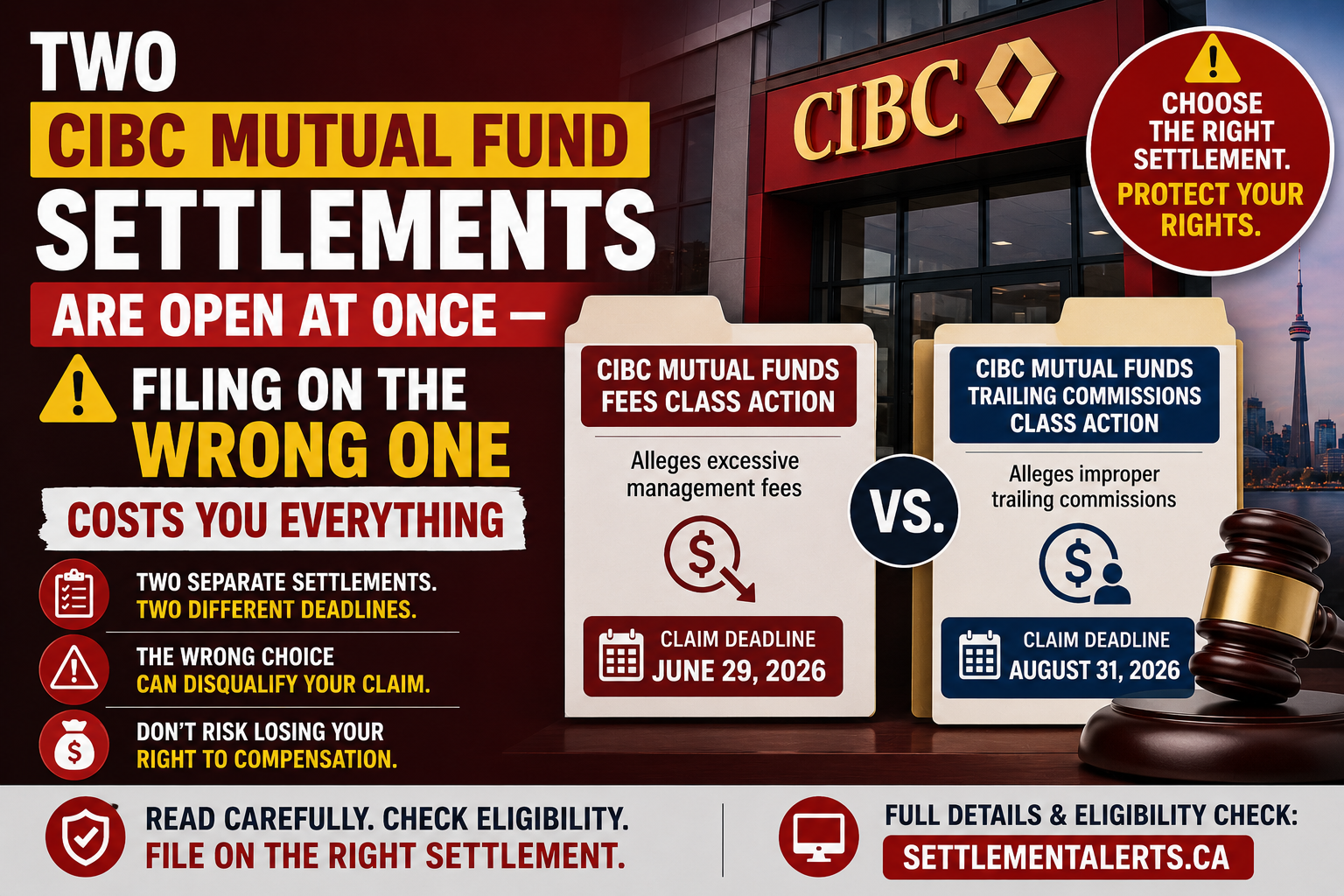
There are two separate CIBC mutual fund settlements open right now. They came out of the same underlying complaint, they have similar names, and they have different deadlines, different claim websites and different eligibility rules.
People are filing on the wrong one. If you do that, your claim gets rejected and by the time you find out, the deadline on the correct settlement may have passed.
Here is how to tell which one is yours.
The one question that decides everything
Did you hold your CIBC or Renaissance mutual funds through a discount broker, or through an advisor?
A discount broker is a self-directed platform where you pick your own investments with no advisor attached — CIBC Investor’s Edge, TD Direct Investing, RBC Direct Investing, BMO InvestorLine, Scotia iTRADE, National Bank Direct Brokerage, Questrade and similar services.
If you bought through a financial advisor, a full-service account, or a branch rep, that is not a discount broker.
That single distinction puts you in one settlement or the other. You cannot be in both for the same holdings.
Settlement 1: The $26 million discount broker settlement
Who it covers: anyone, anywhere in the world, who held units of a CIBC Mutual Fund trust or a Renaissance Mutual Fund trust through a discount broker between September 18, 2003 and January 25, 2024.
Amount: C$26 million, approved by the Ontario Superior Court of Justice in April 2026.
Deadline: October 21, 2026.
Where to claim: the official discount broker settlement site
This is the bigger fund and the longer class period — more than twenty years. Claims are not accepted by email. The online portal is the fastest route, but the administrator also takes claim forms by mail or courier if you request one.
One detail that trips people up: if you had multiple accounts with CIBC or Renaissance, you may have received several notices, each with its own claim ID and PIN. Those have to be submitted separately. One filing does not automatically cover all of your accounts.
Settlement 2: The $11 million advisor settlement
Who it covers: anyone who held units of a CIBC mutual fund trust or a Renaissance mutual fund trust at any time on or before September 5, 2025, other than through a discount broker.
Amount: C$11 million, approved in May 2026.
Deadline: reported as November 18, 2026 for former holders. Confirm the exact date on the official settlement website before you rely on it.
There is an important wrinkle here. If you still hold the units, compensation is expected to be applied to your mutual fund account automatically — you do not file anything. If you previously held units and no longer do, you have to submit a claim form or you get nothing. Former holders are the group most likely to miss out, because nobody is going to credit an account you closed.
What the case was actually about
Trailing commissions — trailer fees — are ongoing payments made out of a mutual fund’s assets to the dealer who sold it. The justification is that the dealer provides advice to the investor over time.
Discount brokers are not permitted to give investment advice. The plaintiffs alleged that investors who bought through those platforms were paying for a service they were structurally barred from receiving, and that those fees reduced the value of their holdings year after year. Class counsel Siskinds LLP maintains a case page covering the broader set of trailing commission actions against multiple fund managers, not just CIBC.
Neither settlement is an admission of liability or wrongdoing by CIBC. Both are described by the parties as a compromise to resolve disputed positions without a trial.
If that pattern sounds familiar, it should. It is the same shape as the Scotiabank NSF fee settlement: a charge applied quietly and repeatedly across a huge customer base, where no individual amount was large enough for anyone to fight over alone.
How much will you get?
Nobody knows yet, and be sceptical of any site that gives you a firm per-person number.
Payouts in the discount broker settlement are calculated on a pro-rata basis after the October 21 deadline passes and all valid claims are processed. The size of your share depends on how much you held, for how long, and how many valid claims come in. A long-term holder with substantial balances across two decades is in a very different position from someone who held a small position for a year.
What that means practically: file even if you think your amount will be small. You cannot know until distribution, and the cost of filing is a few minutes.
What to do this week
Check your old statements first. The discount broker class period reaches back to 2003. Accounts you closed years ago still count. If you cannot remember whether a holding was through Investor’s Edge or through an advisor, the account statements will say.
Look for a notice you may have ignored. Many class members were emailed or mailed a claim ID and PIN. If you deleted it, contact the administrator — they may already have your information on file, which makes filing much faster.
Do not pay anyone to file for you. Both claim processes are free. Class counsel fees come out of the approved settlement fund, not out of your pocket. Anyone asking for an upfront fee to “process your settlement claim” is not part of this — the same warning applies to every open claim we cover, including the CRA data breach settlement.
Do not file on both. Filing a claim you are not eligible for is not a harmless attempt. Administrators screen for it, and it puts your legitimate claim at risk.
The October 21 deadline is the one to watch. It is the larger fund, the wider class, and it arrives first. If you are working through several open claims at once, the Silk and Great Value recall settlement closes just five days earlier, on October 16.
More open settlements
- Scotiabank $10.45M Settlement: Are You One of the 148,000?
- $7.5M Silk and Great Value Recall Settlement: Who Can Actually Claim
- CRA Data Breach Settlement Canada 2026
- Ontario Jail Lockdown $59 Million Settlement
- Canada’s Military Racism Lawsuit: Up to $35,000
This article is general information, not legal or financial advice. Settlement terms, deadlines and eligibility rules can change. Always confirm details on the official settlement website or with class counsel before filing.

Tyler Bernick is a content writer covering Canadian settlement updates, scam alerts, and consumer rights. He aims to simplify complex legal topics and provide clear, reliable information to help Canadians make informed decisions.
Discover more from Settlement Alerts
Subscribe to get the latest posts sent to your email.