
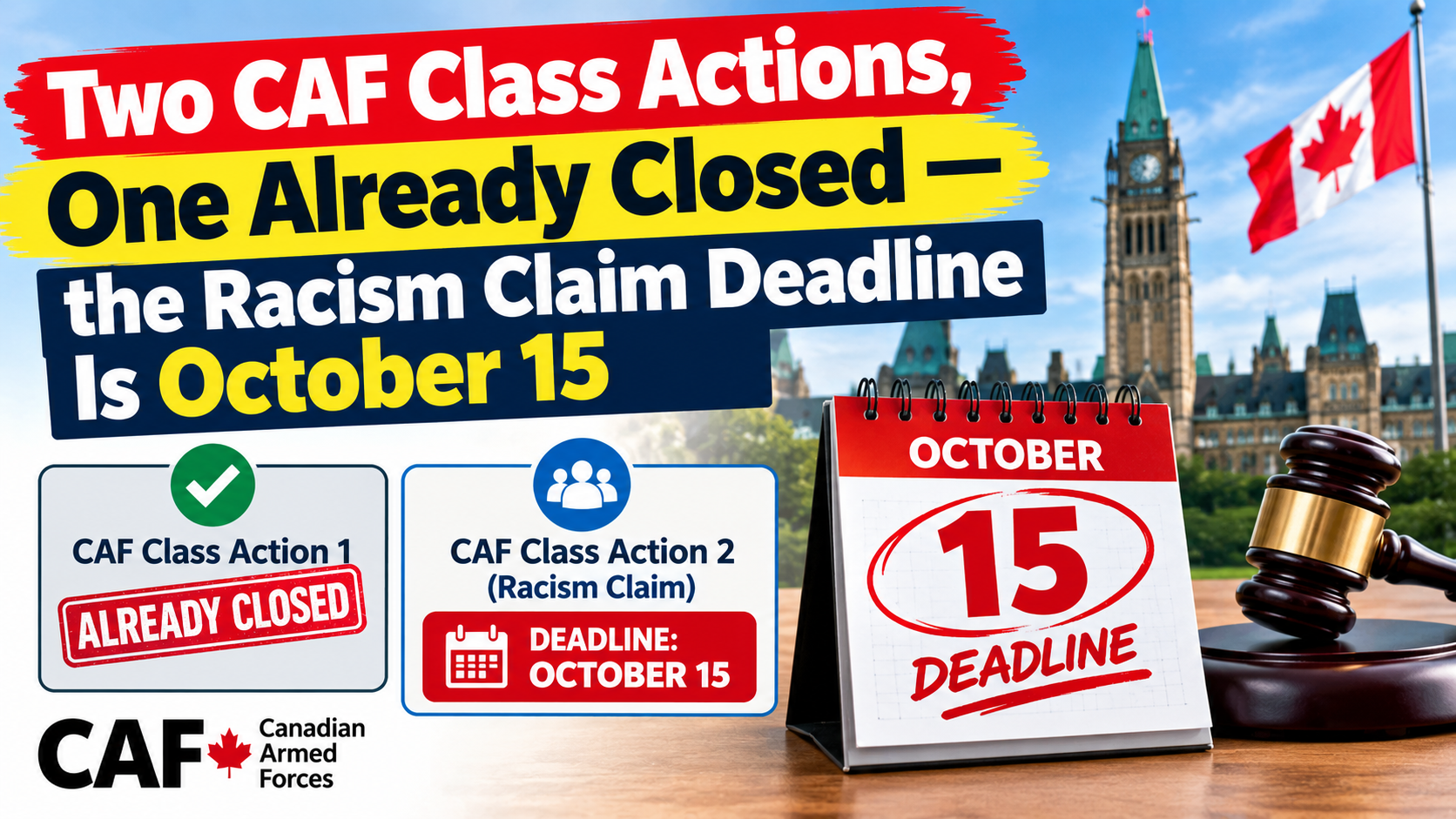
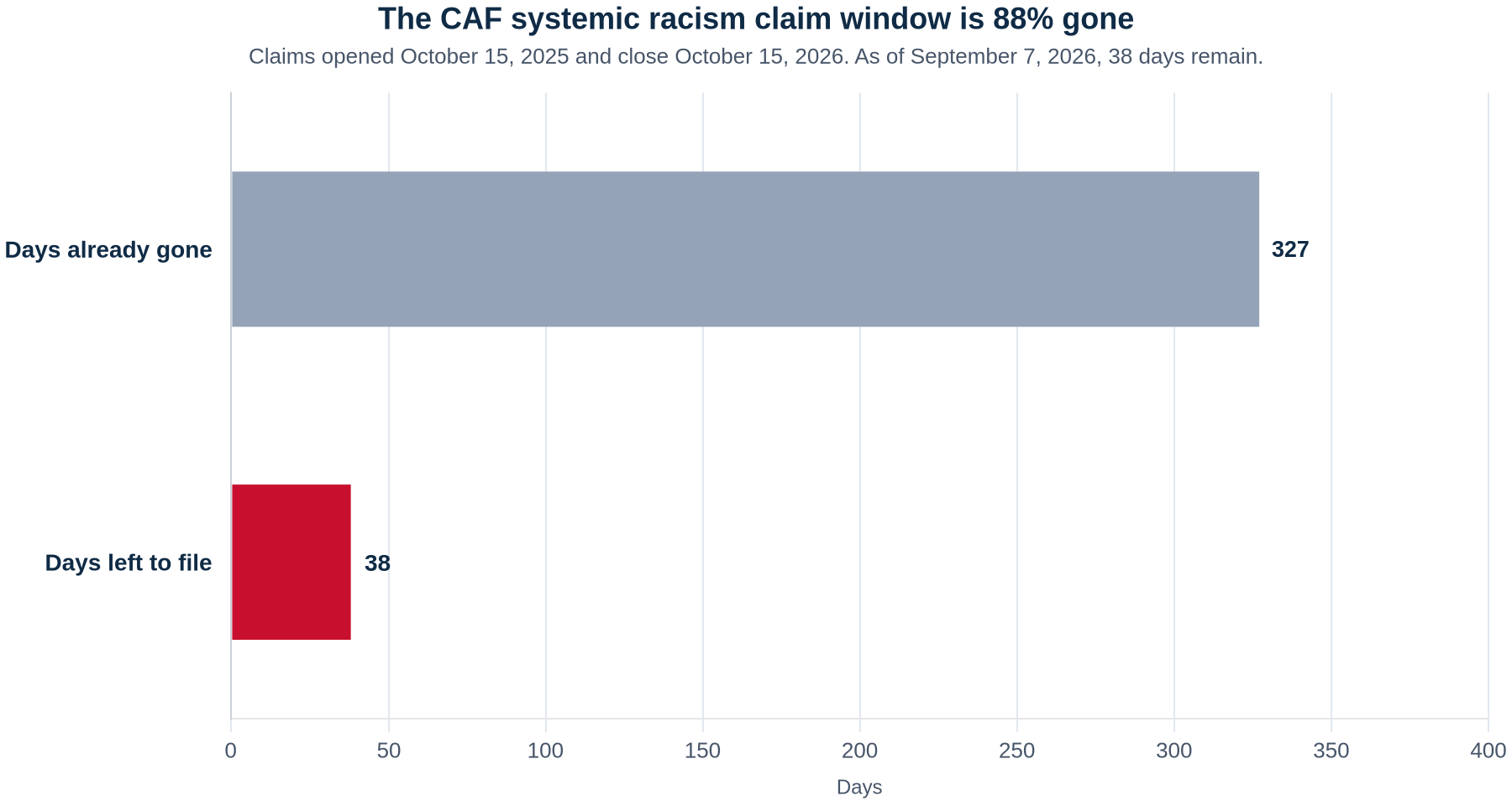
If you served in the Canadian Armed Forces and you have been meaning to get around to the systemic racism class action claim, the window closes on October 15, 2026. As of September 7, that is 38 days.
The claims period opened on October 15, 2025 and was set for a fixed twelve months. National Defence has been posting reminders since. Most of that year is already gone.
There is a second reason to read carefully. A different Canadian Armed Forces class action — the delayed pension case — closed its claims period on March 30, 2026, and it still turns up on “open settlements” roundups. These are two separate cases with two separate deadlines, and only one of them is still accepting claims.
Who the settlement covers
This is the settlement we wrote about in May, now in the last stretch of its claims period.
Who is eligible: current and former CAF members who experienced racial discrimination or racial harassment in connection with their military service between April 17, 1985 and January 10, 2025.
Deadline: October 15, 2026.
Claims administrator: Deloitte, at cafrd@deloitte.ca or 1-844-720-0499. Deloitte is independent of the Department of National Defence and is the only body that assesses claims.
The opt-out date has long passed. It was April 10, 2025. If you did not opt out then, you are in the class, which in practice means this claims process is the route available to you rather than one option among several.
What it pays, and what nobody can tell you yet
National Defence publishes a range: individual compensation for eligible class members runs from $5,000 to $35,000, “as determined by the Claims Administrator in accordance with the Final Settlement Agreement.”
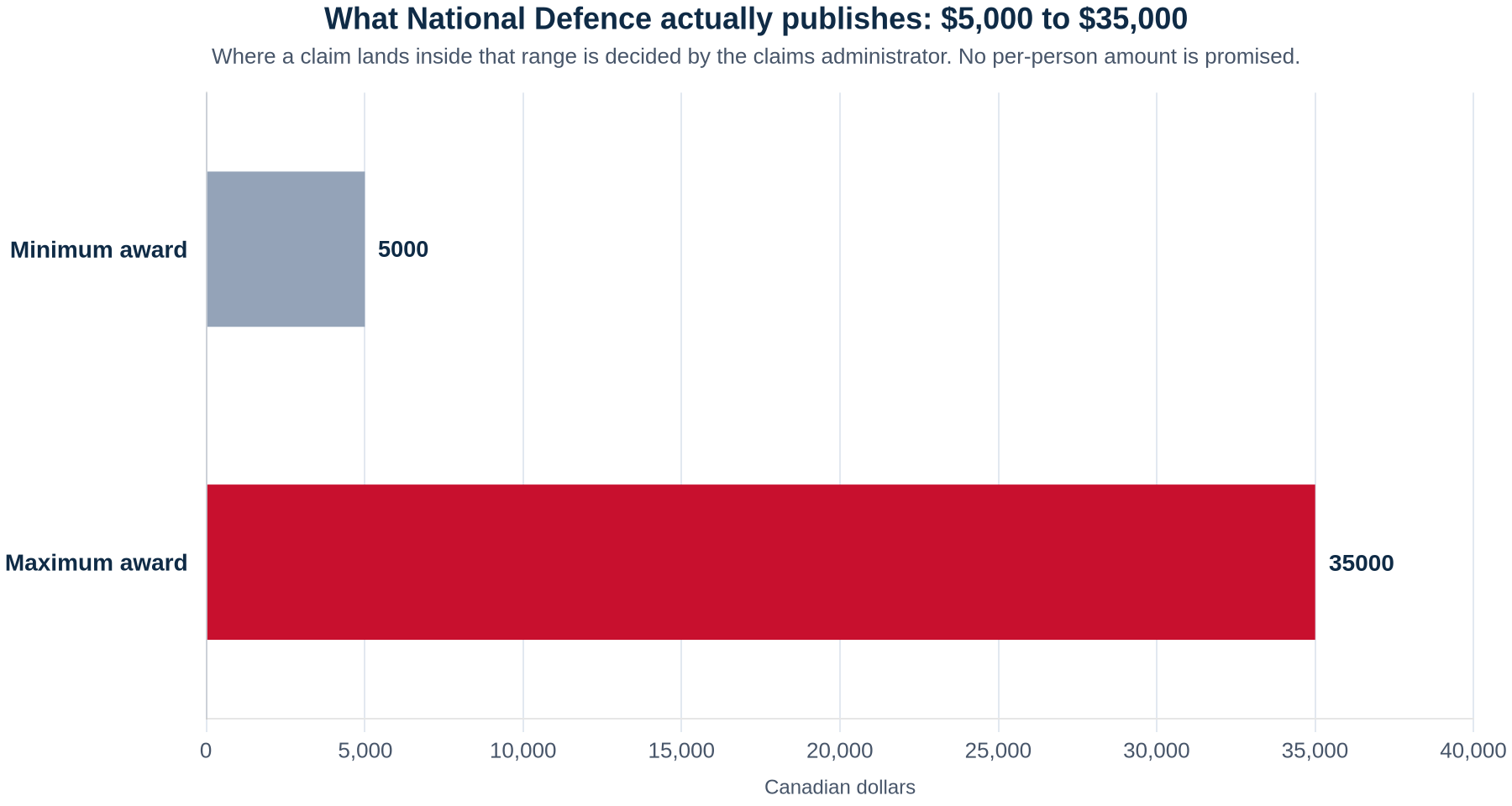
That is the whole of what is officially published. Where any individual claim lands inside that range depends on an assessment of the narrative you submit — the duration and severity of what you experienced, and its effect on you. It is a judgement made by an assessor after you file, not a formula you can run in advance.
So be sceptical of any site that gives you a firm per-person number for this settlement. Nobody outside the claims administrator has one, and the ones circulating are guesses dressed up as figures.
The same goes for the total. A “$150 million” fund figure appears on several aggregator sites. It does not appear on any of the federal government’s own pages for this class action, and the Minister’s statement on the settlement gives no dollar total at all. Do not budget against a number the government has not published.
The part that is not money
Eligible members can also request a personalized apology letter from the Chief of the Defence Staff, and take part in Restorative Engagement sessions where they share their experience directly with senior CAF leadership. Both sit alongside the payment rather than replacing it. Neither happens automatically — they are requested.
The other CAF case that already shut
The Canadian Armed Forces Delayed Pension class action is a separate matter entirely. It covered reservists who waited too long for a pension benefit to be paid, and its claims period closed at 23:59 EST on March 30, 2026.
That case is finished as far as new claims go. It nonetheless keeps appearing on “class actions you can still claim” lists, which is the single most common failure in this corner of the internet — a closed claim listed as open, month after month, because nobody rechecks the administrator’s own page. We ran into the same pattern when mapping which settlement deadlines actually close in October.
If you filed on the pension case before March 30, your claim is in the system and you wait. If you did not, contact class counsel at Koskie Minsky rather than a claims-finder website, and ask what, if anything, is still available to you.
What to do this week
Start the claim now rather than in October. This is not a form you complete in ten minutes. The higher compensation levels rest on a written account of what happened and what it did to you, and that takes time to put down properly. Leaving it to the final weekend is how people end up submitting something thin.
Go to the administrator directly. Deloitte runs the claims administration for this settlement. Reach it at cafrd@deloitte.ca or 1-844-720-0499, or through the Canadian Armed Forces Racial Discrimination and Racial Harassment Class Action Claims Administration site. Class counsel is Stewart McKelvey. Those are the two organisations involved. Nobody else is.
Do not pay anyone to file this for you. Submitting a claim in a class action settlement costs nothing. Any outfit offering to “process,” “expedite” or “maximise” your claim for a fee or a percentage is not part of the settlement and cannot make the administrator move faster. The same fee-charging operations attached themselves to the CRA data breach settlement the moment it opened.
Treat any text or email about your claim as suspect. Deadlines generate phishing, reliably. The pattern is a message saying your claim needs verification before it can be paid, with a link asking for your SIN, service number or banking details. Neither the administrator nor National Defence needs those over a link you did not request. Type the address in yourself, or phone the number above.
Check whether anything else of yours is closing. October is dense this year — two separate CIBC mutual fund settlements and the Silk and Great Value recall claims all run out within days of each other, and the CAF deadline sits in the middle of them.
More open settlements
- $7.5M Silk and Great Value Recall Settlement — deadline October 16
- Canada’s $32.5 Billion Tobacco Settlement — the window that runs to September 2027
- Capital One’s $35M Canadian Data Breach Settlement
- The GST/HST credit is gone — what replaced it, and what lands October 5
Dates and compensation figures are as published by the Department of National Defence as of September 7, 2026, and the count of days remaining is calculated from that date. This article is general information, not legal or financial advice. Confirm your own eligibility and deadline on the official claims administration website or with class counsel before you rely on anything here.

Tyler Bernick is a content writer covering Canadian settlement updates, scam alerts, and consumer rights. He aims to simplify complex legal topics and provide clear, reliable information to help Canadians make informed decisions.
Discover more from Settlement Alerts
Subscribe to get the latest posts sent to your email.