
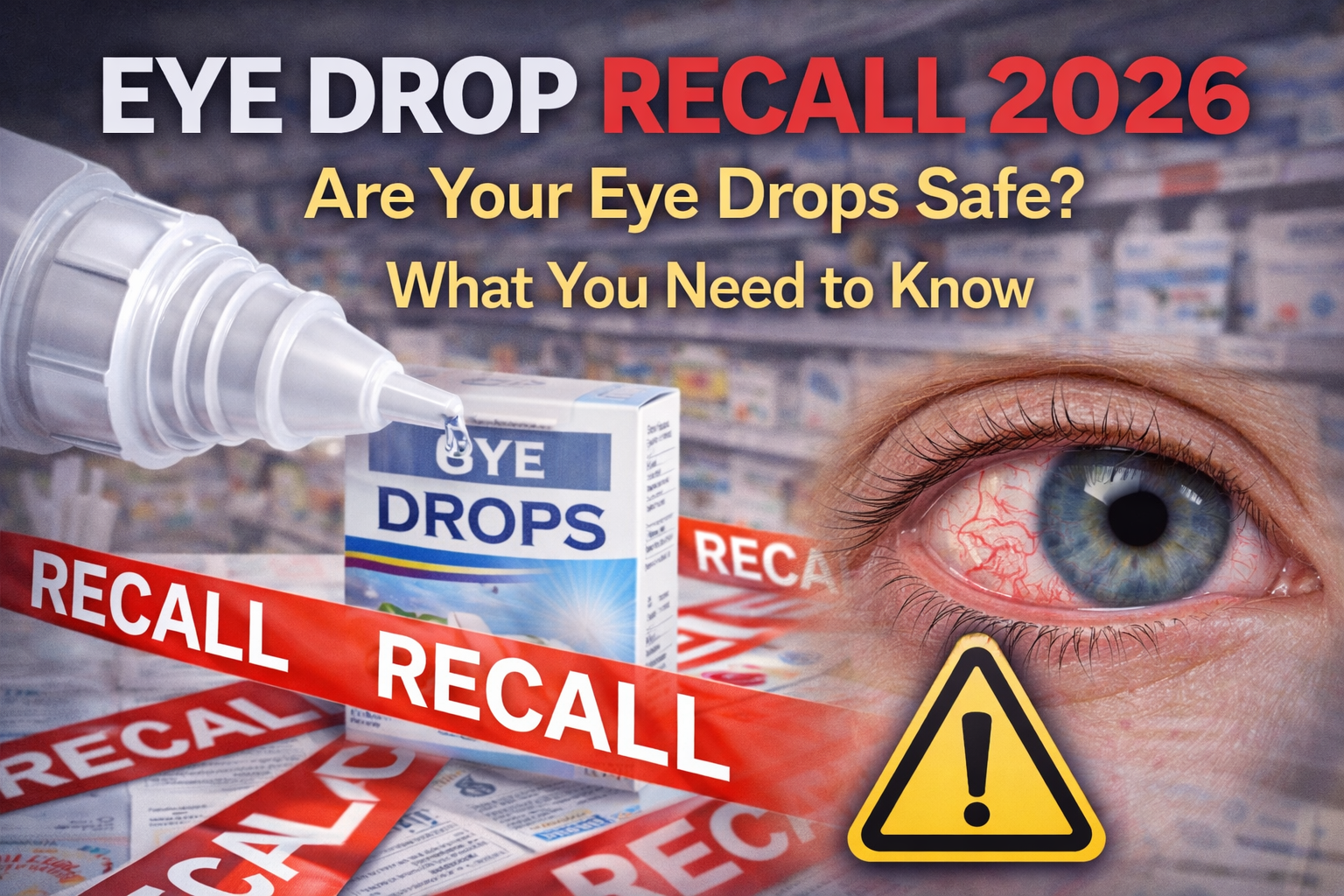
Eye drop recalls are making headlines again in 2026, raising serious concerns about product safety and consumer health. For many people, eye drops are a daily essential — used for dryness, allergies, or irritation — which is exactly why recalls in this category matter more than most.
Because eye drops go directly onto one of the most vulnerable parts of the body, even minor manufacturing problems can pose real health risks. If you or someone in your household uses eye drops regularly, here is how recalls work, what happened in recent major cases, how to check whether your product is affected, and when compensation becomes possible.
What eye drop recalls are about
Recalls of over-the-counter and prescription eye products are typically triggered by:
- Contamination risks — bacteria or fungi detected in the product or facility
- Sterility concerns — manufacturing conditions that can’t guarantee a sterile product
- Manufacturing defects — faulty seals, packaging or dosing
- Labelling errors — wrong concentrations or missing warnings
Unlike most consumer products, eye drops must be completely sterile. There is no “minor” contamination when the product is applied directly to the eye.
Why regulators treat these recalls so seriously
The 2023 artificial tears crisis showed how bad it can get. Contaminated imported eye drops sold in North America were linked by U.S. health authorities to a drug-resistant Pseudomonas aeruginosa outbreak that caused serious eye infections, cases of permanent vision loss, and several deaths. That single episode triggered a wave of recalls across dozens of store-brand and discount eye products, and pushed both the FDA and Health Canada to tighten scrutiny of eye drop manufacturing.
It is the reason every eye drop recall since has been treated as urgent — the worst-case outcome is not a refund issue, it is someone’s eyesight.
How to check if your eye drops are affected
Recall notices name specific brands, lot numbers and expiry dates — never assume based on headlines alone. To confirm:
- Find the product name, lot/batch number and expiry date on your bottle or box.
- Check Health Canada’s Recalls and Safety Alerts database — the official source for every recall affecting products sold in Canada.
- Compare your lot number against the notice. Only listed lots are affected.
- When in doubt, ask your pharmacist — pharmacies receive recall notices directly and can check in seconds.
Affected product types in past recalls have included artificial tears, allergy relief drops and lubricating solutions — including major store brands, not just obscure labels.
Symptoms to watch for
If you have used a recalled product, monitor for warning signs of infection:
- Burning or stinging beyond the usual momentary sensation
- Redness or swelling that worsens over days
- Increased sensitivity to light
- Yellow, green or watery discharge
- Blurred vision or the feeling of something in the eye
Eye infections can escalate quickly. If symptoms appear after using a recalled product, see a doctor or optometrist promptly and tell them exactly which product and lot you used — that detail changes the treatment.
What to do immediately
- Stop using the product — even if you have no symptoms.
- Keep the bottle and packaging. The lot number is your proof for refunds and any future claim.
- Follow the recall notice instructions — usually return to the retailer for a refund or safe disposal.
- Document any symptoms with dates, photos and medical visits.
Are you eligible for compensation?
Not every recall leads to compensation, but a predictable pattern applies:
| Situation | Likely outcome | What to keep |
|---|---|---|
| Bought a recalled product, no harm | Retailer refund or replacement | Product, packaging, receipt if available |
| Minor irritation, treated at home | Refund; possible claim if a class action forms | Product, pharmacy records, notes with dates |
| Infection requiring medical care | Potential class action or individual claim | Full medical records, product and lot number |
| Serious or permanent harm | Legal advice strongly recommended | Everything above, plus specialist reports |
When recalls involve documented injuries — as the 2023 artificial tears outbreak did — class actions typically follow. The pattern mirrors the Silk and Great Value recall settlement, where a 2024 product recall became a court-approved compensation fund with claims open through October 2026. Recall today, settlement in one to three years is the normal timeline — which is why keeping documentation now matters.
Eye drop recall scams
Whenever recalls make headlines, scams follow. Be cautious of emails claiming compensation without verification, fake recall websites, and requests for personal or financial information. Real recall refunds run through the retailer or manufacturer; real settlements run through court-appointed administrators — never through a text message link. Our guide on how to check if a settlement is real or fake covers the verification steps.
How to stay safe going forward
- Check labels and expiry dates before every purchase
- Buy from licensed pharmacies and established retailers
- Never use damaged, cloudy or previously opened products
- Follow storage instructions and discard drops after the post-opening period on the label
- Check Health Canada’s recall database when a headline mentions eye products
Final takeaway
Eye drop recalls are a reminder that even everyday products carry risk when safety standards slip — and the 2023 outbreak proved the consequences can be permanent. Check your products against official recall lists, stop using anything affected, keep your documentation, and treat any post-use symptoms as urgent.
Your eyesight is not something to gamble on a $10 bottle.
You may also like
Canadians May Be Eligible for New Settlement Payments in 2026 — Check If You Qualify
Silk and Great Value Recall Settlement: Claim Up to $300,000 Before October 16
Top Settlement Scams in Canada (2026): How to Stay Safe and Protect Your Money

Tyler Bernick is a content writer covering Canadian settlement updates, scam alerts, and consumer rights. He aims to simplify complex legal topics and provide clear, reliable information to help Canadians make informed decisions.
Discover more from Settlement Alerts
Subscribe to get the latest posts sent to your email.