
As the cost of living continues to rise across Canada, fuel prices remain one of the biggest concerns for households. In this context, discussions around a potential gas tax cut associated with Mark Carney have drawn attention nationwide.
For many Canadians, even a small change in gas prices can significantly affect monthly expenses. But what exactly is being proposed, and how could it impact your finances, the economy, and Canada’s long-term goals? The situation is more complex than it appears — and understanding it fully is important before drawing conclusions.
What is the gas tax cut proposal?
A gas tax cut refers to reducing or temporarily removing federal taxes applied to gasoline and diesel. These taxes are a key part of Canada’s fuel pricing system and contribute to government revenues.
The idea is simple: lower taxes → lower fuel prices → immediate financial relief for consumers. In practice, the outcome depends on several factors, including global oil prices, supply chains and market behaviour. The discussion is tied to broader economic concerns — particularly inflation and affordability — which have dominated Canadian politics in recent years.
Why gas prices are a major issue in Canada
Fuel costs are not just about what drivers pay at the pump — they ripple through the entire economy. Higher gas prices can lead to:
- Increased transportation costs for goods
- Higher food prices due to delivery expenses
- Rising costs for businesses and services
- Greater pressure on household budgets — pressure that, at its worst, shows up as bounced bills and NSF fees like the ones behind the Scotiabank settlement
Because of this, any policy that reduces fuel costs can have a wider economic impact far beyond drivers.
Mark Carney’s economic perspective
Mark Carney, former Governor of the Bank of Canada and Bank of England, is widely known for his focus on economic stability, inflation control and long-term sustainability.
While gas tax cuts are often framed as a quick fix for rising costs, Carney’s broader approach emphasizes managing inflation responsibly, supporting long-term growth, and balancing affordability with environmental commitments. Any fuel-tax measure under his government sits inside a larger economic strategy — covered in our full breakdown of Mark Carney’s economic plan for Canada in 2026 — rather than standing alone.
Potential benefits of a gas tax cut
1. Immediate relief at the pump
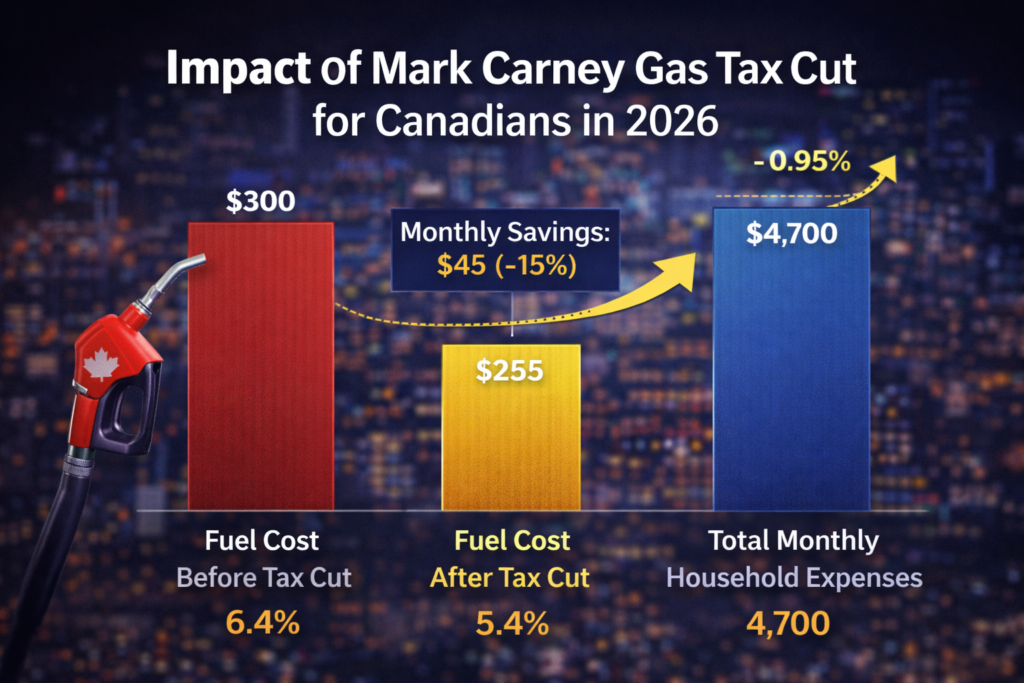
Lower taxes translate into lower posted prices, helping drivers save right away. For commuters and families who rely on vehicles, this means noticeable monthly savings — a two-car household filling up weekly feels even a few cents per litre quickly.
2. Reduced inflation pressure
Since fuel costs feed into nearly every sector, lower gas prices can help stabilize overall inflation and indirectly reduce the cost of goods and services.
3. Increased consumer spending
When people spend less on fuel, they have more disposable income for other expenses, stimulating economic activity elsewhere.
Concerns and challenges
1. Environmental impact
Lower fuel prices may encourage increased consumption, which can conflict with Canada’s climate goals. Reducing emissions and transitioning to cleaner energy remain federal priorities.
2. Loss of government revenue
Fuel taxes fund infrastructure, public services and transportation systems. Cutting them creates budget gaps that must be filled elsewhere — through other taxes, borrowing or spending cuts.
3. Temporary nature of relief
Critics argue a gas tax cut is a short-term patch. Pump prices are heavily driven by global oil markets, so a tax reduction can be swallowed by a swing in crude prices within weeks.
How much could Canadians actually save?
Actual savings depend on the size of the reduction, current fuel prices and regional differences. A small cut might shave a few cents per litre; a larger one produces more visible savings. As a rough guide:
| Tax reduction | Savings per 50L fill-up | Approx. monthly savings (1 fill/week) |
|---|---|---|
| 3¢/litre | $1.50 | ~$6 |
| 5¢/litre | $2.50 | ~$10 |
| 10¢/litre | $5.00 | ~$20 |
| 15¢/litre | $7.50 | ~$30 |
These figures shift with global oil supply and demand — the tax is only one layer of the pump price.
Impact on different groups
Urban residents
People living in cities with access to public transportation may see limited direct benefit, though lower delivery costs can still soften prices on goods.
Rural and suburban Canadians
Households that rely heavily on personal vehicles — with longer commutes and no transit alternative — benefit most from lower fuel prices.
Businesses
Companies dependent on transportation and logistics see reduced operating costs, which may or may not be passed on to consumers.
Long-term considerations
While a gas tax cut may provide short-term relief, policymakers must weigh longer-term questions: How is the lost revenue replaced? Does the policy align with environmental commitments? Is this the most effective way to address affordability compared with targeted benefits?
Canada is simultaneously investing in electric vehicles, public transportation and clean energy initiatives — fuel-tax decisions have to fit alongside those objectives.
What Canadians should watch next
As discussions continue, keep an eye on federal budget announcements, policy updates on fuel taxation, and statements from economic leaders. Fuel-tax decisions are driven by both economic conditions and political priorities — and they interact with everything from the Bank of Canada’s interest rate path to household benefit programs.
Final takeaway
The idea of a gas tax cut in Canada highlights the ongoing challenge of balancing affordability with long-term economic and environmental goals. A cut associated with Mark Carney’s government could deliver short-term relief — but fuel prices answer to global markets, and any change must be designed to help households without creating bigger gaps elsewhere.
For now, Canadians should stay informed and watch closely as the policy discussion evolves.

Tyler Bernick is a content writer covering Canadian settlement updates, scam alerts, and consumer rights. He aims to simplify complex legal topics and provide clear, reliable information to help Canadians make informed decisions.