
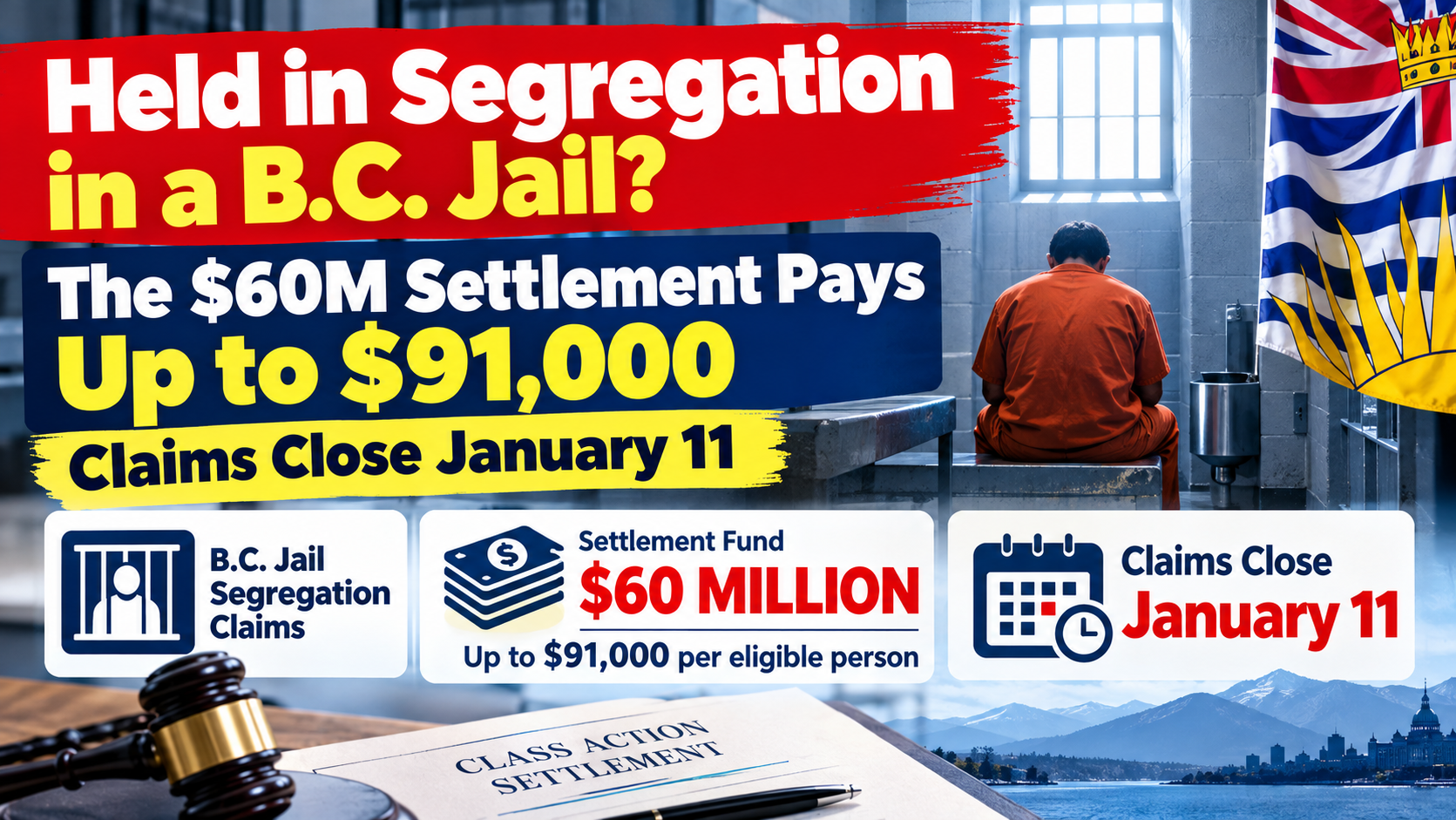
If you spent time alone in segregation or separate confinement in a B.C. jail at any point in the last twenty years, there is money set aside for you — and you have until January 11, 2027 to ask for it.
The B.C. government settled the North v. British Columbia class action for up to $60 million. The B.C. Supreme Court approved it on October 22, 2025. Claims opened January 10, 2026. After that date, anyone who has not filed gets nothing — and, under the settlement, still cannot sue B.C. separately over those placements.
The catch is that nobody files for you. Even if you talked to a lawyer, a support worker or class counsel years ago, the notice is clear: you still have to submit your own claim form.
Who is covered
Time period: April 18, 2005 to October 22, 2025.
Where: a provincial B.C. Correctional Centre — the jails run by B.C. Corrections, such as North Fraser Pretrial, Surrey Pretrial, Fraser Regional, Nanaimo, Kamloops Regional and Prince George Regional. Federal penitentiaries are not part of this case.
You fit into one of two groups:
The Prolonged Class
You were placed in separate confinement or segregation for 15 or more days in a row.
The SMI Class
You spent at least 22 consecutive hours in separate confinement or segregation, and your records show B.C. Corrections knew or ought to have known you had a serious mental illness. The settlement lists the qualifying diagnoses, including schizophrenia, bipolar disorder, major depressive disorder, PTSD, OCD and borderline personality disorder. The full list is in the official notice.
Days spent apart from the general population only because of COVID-19 protocols do not count.
How much the settlement pays
There are two pots of money, and one claim form puts you in line for both.
Common Experience Payment: everyone approved in the Prolonged Class gets the same amount, up to $3,000. Everyone approved in the SMI Class gets the same amount, up to $6,000. These are paid first.
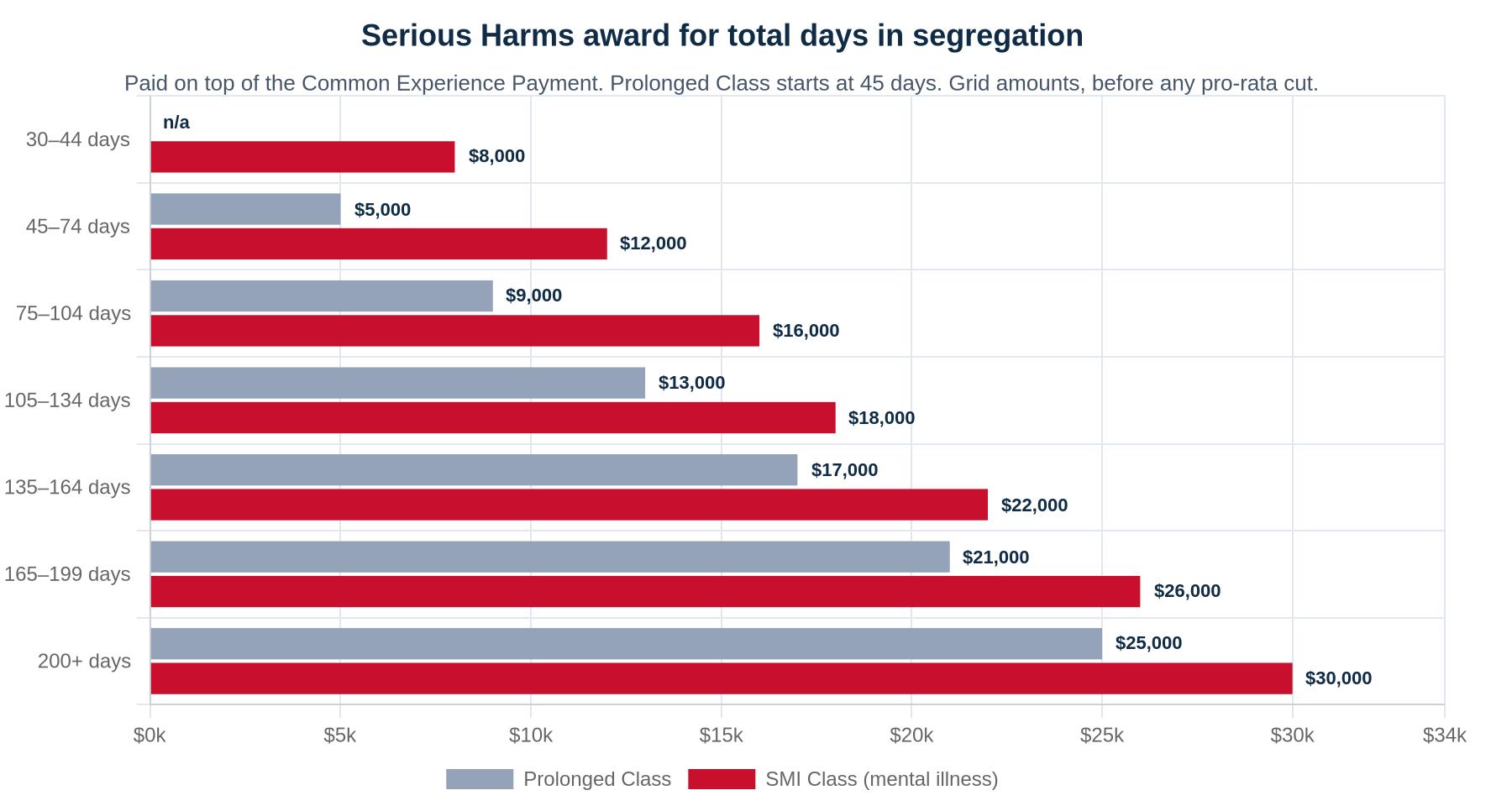
Serious Harms Award: paid on top, if you had lengthy or repeated placements or a specific harm recorded in your file. The chart above shows the grid for total time in segregation across all eligible placements. A separate category pays fixed amounts for recorded harms during or shortly after a placement — $10,000 for self-injury, $35,000 for a new mental illness diagnosis or a non-court-ordered transfer to a mental health facility, and $40,000 for a suicide attempt.
The ceiling: no one can receive more than $85,000 from the Serious Harms Fund. Add the top Common Experience Payment and the official notice puts the maximum at $91,000 per person. Very few people will get that.
Why “up to” matters
Every one of those numbers is a maximum. The settlement agreement says Common Experience Payments are reduced pro rata if too many people claim, and Serious Harms Awards are reduced pro rata if that fund runs short. How many valid claims come in decides the final amount. Nobody knows that yet, and be sceptical of any site that gives you a firm per-person number.
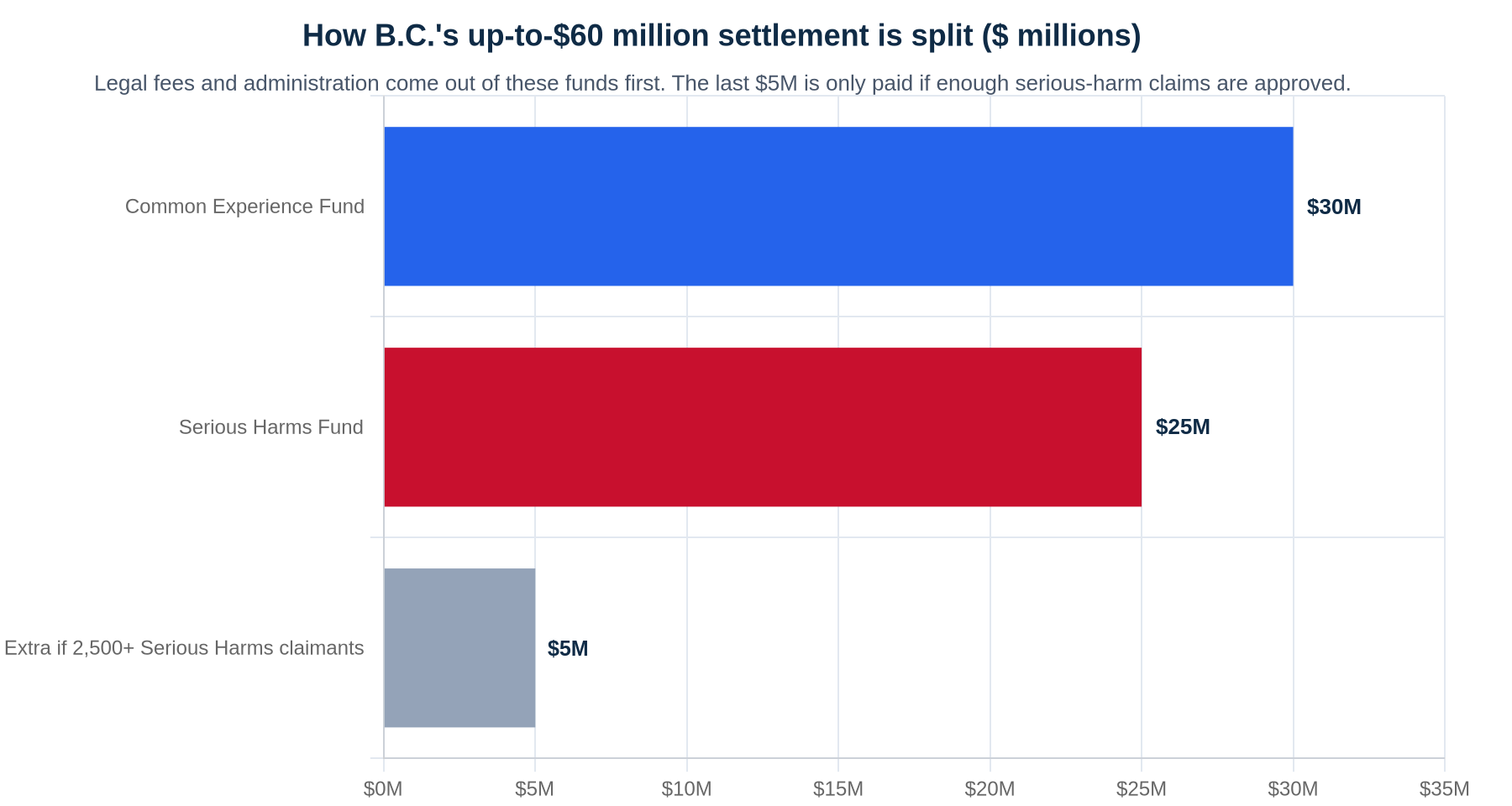
Here is the mechanism. The Common Experience Fund holds $30 million. The Serious Harms Fund holds $25 million, plus another $5 million only if more than 2,500 people qualify for Serious Harms Awards. That is where the “up to $60 million” comes from. Court-approved legal fees and administration costs are paid out of these funds before claimants are.
If money is left in the Common Experience Fund, it rolls into the Serious Harms Fund. Anything left after that goes to the Inmate Benefit Funds at B.C. correctional centres. It does not go back to the province.
The older-placement problem
If your only placements ended before November 26, 2016, or happened between December 23, 2020 and July 30, 2022, your claim is presumed to be out of time. You can still try. You go through a separate Statute-Barred Claims Process, where you have to show evidence of incapacity that stopped the clock. File the regular claim form anyway — the administrator or class counsel will contact you about the next step.
If your time inside was in Ontario rather than B.C., this settlement does not cover you — but the Ontario jail lockdown settlement might, and it has its own deadline.
You do not need your own records
This is the part that stops people from filing, and it should not. The claim form asks you to authorize access to your correctional and medical records. B.C. has agreed to hand those records to the administrator. You do not need to remember exact dates or count days yourself.
If you are in a B.C. jail right now, you can still claim. Ask on your living unit for a claim form and a prepaid return envelope. If you are on probation or parole, your probation and parole office in B.C. can give you one.
What to do this week
File the claim, even if you are unsure. Use the official online claim portal, email the form to bcsegregation@proactio.ca, or call the administrator, Proactio, at 1-877-916-1122 to have a paper form mailed. For paper claims, the Canada Post postmark counts as your filing date.
Get free help if you need it. Class counsel, Koskie Minsky LLP (1-877-398-0497) and McEwan Partners LLP (604-283-8016), will help you complete the form. The notice says you will not be personally charged for their work. Their fees were approved by the court and come out of the settlement.
Do not pay anyone to file for you. The claim is free. Anyone asking for an upfront fee or a percentage of your payment to “process” this settlement is not part of it. Be just as careful with texts or emails claiming you have money waiting and asking for your SIN or banking details. The administrator will not ask you for payment.
Do it before the holidays. January 11 falls right after a stretch when mail is slow and offices close. Late claims are accepted only in limited circumstances.
Look after yourself. Filling out this form can bring back hard memories. If you are struggling, you can call or text 9-8-8 any time.
If you are tracking several deadlines, the Canadian Armed Forces racism claim closes October 15, and the Government of Canada account breach settlement runs until February 2027.
More open settlements
- Ontario Jail Lockdown $59 Million Settlement
- Nova Scotia Disability Waitlist Settlement: Claims Close March 17, 2027
- Manitoba $445M CSA Settlement Closes January 5
- Quebec Opioid Settlement: File Before November 30
Figures and deadlines are as of October 3, 2026, taken from the court-approved notice and settlement agreement published by the claims administrator. This article is general information, not legal or financial advice. Settlement terms and deadlines can change. Always confirm details on the official settlement website or with class counsel before filing.

Tyler Bernick is a content writer covering Canadian settlement updates, scam alerts, and consumer rights. He aims to simplify complex legal topics and provide clear, reliable information to help Canadians make informed decisions.
Discover more from Settlement Alerts
Subscribe to get the latest posts sent to your email.