
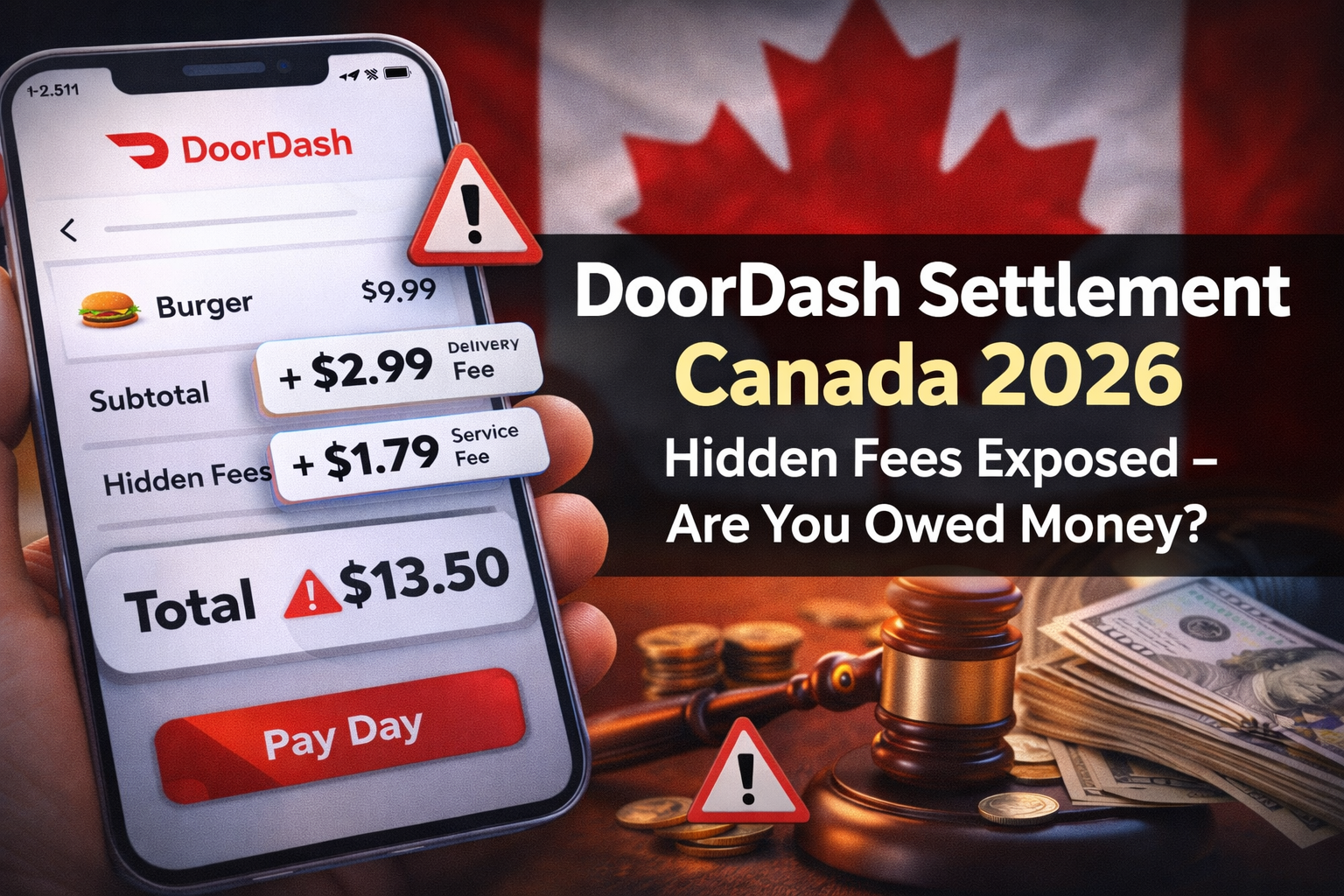
Executive Summary: Canada’s Competition Bureau and consumer lawyers are taking DoorDash to court for using “drip pricing” – advertising low prices then adding hidden delivery/service fees at checkout. In June–July 2025, official legal actions were launched: a federal case by the Competition Bureau (Competition Tribunal application) and multiple proposed class actions in Quebec and British Columbia (covering all of Canada). Allegations are that DoorDash’s platform routinely added mandatory fees (service, delivery, “expanded range,” small-order and other fees, some disguised as taxes) so that customers paid up to ~$1 billion more than advertised prices. DoorDash denies wrongdoing, saying fees are clearly disclosed. If you ordered food on DoorDash and paid extra fees, you may be eligible to share in any recovery. This article explains the legal basis (federal Competition Act and provincial consumer laws), summarizes the case filings, discusses likely outcomes and precedents, and gives practical steps for Canadians to join the action (or pursue their own claims).
What Happened: Timeline & Background
- Nov 2015: DoorDash (including its Caviar service) launched in Canada. It promised fast, convenient food delivery at advertised prices.
- June 23, 2022: Parliament amended the federal Competition Act to explicitly ban drip pricing – i.e. advertising unattainable prices without including mandatory fees (unless those fees are only government taxes).
- Sep 2024: The Competition Tribunal fined Cineplex $38.9 M for drip pricing (a landmark case enforcing the new law).
- June 9, 2025: The Competition Bureau files a lawsuit (application to the Competition Tribunal) against DoorDash Inc. and DoorDash Technologies Canada Inc., alleging deceptive pricing. The Bureau says DoorDash charged mandatory fees (service, delivery, regulatory “expanded range,” small-order, etc.) after the price was advertised, often calling them “taxes,” thereby misleading consumers and collecting nearly $1 billion in extra fees. The Bureau is seeking an order to stop the practice, fines, and restitution for affected customers.
- June 19, 2025: Law firm Siskinds LLP (Ontario) files a proposed class action in British Columbia’s Supreme Court (Case No. S-130849) on behalf of all Canadians who used DoorDash since Nov 1, 2015 and paid more than the advertised price. The class is defined as “all persons in Canada” who purchased a DoorDash delivery service from 2015 to certification. This lawsuit alleges violations of BC’s Business Practices and Consumer Protection Act (BPCPA) and equivalent consumer laws in other provinces, for concealing mandatory fees and breaching fair-pricing rules. It seeks to recover the difference between the advertised price and the final price paid (i.e. the undisclosed fees).
- July 31, 2025: Law firm Actis Law Group (Quebec) files an amended application for authorization of a class action in Quebec Superior Court (District of Montreal, File No. 500-06-001385-257). The Québec class is defined as all persons residing in Quebec who placed a DoorDash/Caviar order and “were charged more than the base advertised price”. The pleading alleges DoorDash engaged in drip pricing, breaching Québec’s Consumer Protection Act and the Civil Code (good-faith pricing duties). It specifically cites the Competition Bureau’s findings (nearly $1 billion collected in fees) and seeks reimbursement for fees not included in advertised prices (excluding government taxes).
- Pending: These cases await certification (class authorization) or hearings. Notices will be issued if/when they proceed, giving class members a chance to opt out. In the meantime, Canadians who paid hidden DoorDash fees should collect evidence and sign up for updates (see How to Join below).
Drip Pricing Laws: Federal and Provincial Rules
Federal Competition Act: Since June 2022, the Competition Act (R.S.C. 1985, c. C-34) explicitly outlaws advertising an “unattainable price” without including fixed mandatory fees. Sections 52 and 74.01–74.011 make false or misleading price claims (a “deceptive marketing practice”) illegal. The Competition Bureau enforces this by prosecuting or seeking orders from the Competition Tribunal. (Before 2022 this was pursued under general “deceptive marketing” provisions.)
Consumer Protection Acts: Provincial consumer laws similarly ban hidden fees. For example, Québec’s Consumer Protection Act (CQLR c. P-40.1) requires merchants to clearly and fully disclose all costs from the first price display; the Civil Code of Québec also imposes a duty of good faith in pricing. In Ontario, the Consumer Protection Act, 2002 requires that contracts for goods/services include all mandatory charges (other than prescribed taxes) in the advertised price. In British Columbia, the Business Practices and Consumer Protection Act forbids false or misleading advertising (which covers drip pricing tactics). In all provinces, the only mandatory fees that can be omitted from an advertised price are government-imposed taxes (e.g. GST/HST); everything else must be shown to consumers.
Provincial Drill-Down: (See Table below.) All jurisdictions impose limitation periods (usually 2–3 years) for consumer claims. For example, Ontario’s Limitations Act, 2002 generally requires lawsuits within two years of discovering the issue (with a 15-year ultimate limit); Québec law sets a 3-year period from knowledge of the right to sue. Class actions typically “suspend” limitation periods while pending. (Provincial regulators like consumer protection agencies may also handle complaints, but they cannot award damages directly – only the courts or class proceedings can deliver compensation.)
Class Action Lawsuits: Key Allegations and Claims
The competing class actions and federal suit share core allegations: DoorDash advertised a low “base price” for delivery but only revealed mandatory fees at checkout, misleading consumers about the true cost. The mandatory fees (service fees, delivery fees, “expanded range” surcharges, small-order fees, “DoubleDash” fees, etc.) mean that the final price paid is always higher than the price shown up front. These practices allegedly violate both the Competition Act and provincial fair-dealing laws.
- Competition Bureau (Federal Suit): The Bureau’s June 2025 press release notes that DoorDash “charges consumers numerous mandatory fees” (listed above) and thus ends up collecting “nearly $1 billion in mandatory fees” by advertising unattainable prices. The Bureau’s application asks the Competition Tribunal to force DoorDash to stop drip pricing, stop calling fees “taxes,” pay penalties, and refund consumers. (This is a public enforcement case – if the Tribunal orders restitution, that money would go to consumers, but individuals still must register to claim it.)
- Siskinds Class Action (BC Court): The Siskinds complaint (filed June 19, 2025) defines the class as all Canadians who ordered delivery on DoorDash’s site/app from Nov 1, 2015 to present and paid more than the advertised price. It alleges DoorDash breached the Business Practices and Consumer Protection Act (B.C.) and similar statutes elsewhere by concealing mandatory fees. It explicitly seeks “financial damages” equal to the difference between the Advertised Price and the all-in price paid (i.e. the mandatory fees). In other words, it demands to “reimburse the amounts” customers paid in hidden fees.
- Actis Class Action (Quebec Court): The Actis application (July 31, 2025) defines a Québec class of consumers who used DoorDash/Caviar and “were charged more than the base advertised price”. The pleadings emphasize drip pricing as a form of false advertising under Quebec’s Consumer Protection Act and Civil Code. The suit seeks restitution of those extra charges (excluding any government taxes). It also invokes general good-faith duties and the right to “protect the class” by collective recovery of funds.
Defendants: All cases name DoorDash’s Canadian subsidiary (DoorDash Technologies Canada Inc.) and/or the U.S. parent (DoorDash, Inc.) as defendants. Both entities operate DoorDash services across Canada (registered in British Columbia).
DoorDash’s Response
DoorDash has publicly denied any hidden fee scheme. In a June 9, 2025 post on its website, DoorDash stated it “does not hide fees from consumers” and that all charges are disclosed before payment. A spokesperson called the Bureau’s case “misguided” and insisted DoorDash will “vigorously defend” against the claims. The company argues that any fee changes in checkout simply reflect up-to-date information (e.g. distance surcharges when adding items) and that customers always see a final review of all fees. (DoorDash points out it has modified its user interface over time to display fees more clearly.)
Nonetheless, by filing these lawsuits the authorities and plaintiffs contend that the overall pricing structure is inherently deceptive because consumers never see the true total until after entering payment information. The case will turn on whether courts find DoorDash’s fee disclosures adequate under the law. With new legislation and recent fines on drip pricing (e.g. Cineplex), regulators are taking a hard line — the Competition Bureau’s Commissioner has stated publicly that “Parliament has made it clear that businesses must not engage in drip pricing by advertising unattainable prices.”
Legal Basis & Precedents
- Competition Act (s. 52, 74.01–74.011): Advertised prices must include all mandatory, fixed fees; breach is a civil deceptive marketing offense (and, after 2022 amendments, also potentially criminal). The Bureau’s recent filings rely on these sections. The Cineplex case (2024) is the first full test: the Tribunal found Cineplex’s fee labeling misleading and fined it $38.9M. DoorDash’s case will apply the same law to online food delivery.
- Provincial Consumer Laws: Québec’s CPA explicitly requires price quotes to be “final” and prohibits false advertising; a business must disclose any fees up front. Similarly, Ontario’s Consumer Protection Act (s. 14–15) and BC’s BPCPA generally forbid misleading price representations. (For instance, Ontario’s rules on contracts require that the total consideration be clear in the agreement.) Canadian case law on drip pricing is sparse but growing. Under most consumer-protection regimes, undisclosed mandatory fees are unlawful. If the class actions proceed, courts will consider these statutes plus general tort principles (e.g. misrepresentation).
- Existing Actions: Besides DoorDash, regulators have targeted other companies for hidden fees. In 2023 the Competition Bureau fined SiriusXM $3.3M and a class action followed. This trend of enforcement suggests serious legal risk: regulators issued a public consumer alert on drip pricing in late 2024 to warn shoppers. Precedent suggests that DoorDash may face both civil penalties and orders to refund affected customers (directly via class members or through restitution programs). If this follows Cineplex, DoorDash could also be ordered to disgorge illicit profits.
Estimated Damages / Compensation
Determining damages is complex, but we can outline ballpark figures. The Competition Bureau estimates nearly $1 billion in mandatory fees collected by DoorDash from Canadian customers over the last decade. If even a fraction of that is deemed wrongfully charged, the potential recovery could be hundreds of millions. The class action claims damages equal to the total overpayment (advertised vs actual price) for each order. For example, if a meal advertised at $10 incurred $3 in hidden fees, the customer’s claim would be $3. On a class basis, total liability could be enormous, though actual payouts depend on proof of purchases and participation.
In prior consumer class actions (e.g. airline fees, mortgages, SiriusXM), total settlements have ranged from thousands to tens of millions per claimant pool. DoorDash’s case is bigger in scope but also faces rigorous proof requirements. A successful outcome might involve DoorDash refunding a portion of each fee (perhaps prorated if full recovery isn’t feasible), plus possible punitive damages. Note that class actions usually result in pro rata payments (each claimant gets a share of the settlement fund) rather than full individual compensation — the Scotiabank NSF settlement’s ~$43 per-person deposit is a recent example of how pro rata math works out.
Importantly: If the Competition Bureau’s suit succeeds, the Tribunal can order restitution to consumers. In Cineplex, the Tribunal required Cineplex to cease the practice and pay a $39M penalty. DoorDash faces the same legal framework, so even outside the class action, there is pressure for fines and restitution.
How to Join the Class Action or File a Claim
If you used DoorDash in Canada and suspect you paid undisclosed fees, you should take action now to protect your rights. Here’s what to do:
- Gather Evidence: Keep any receipts, email confirmations, or screenshots of your DoorDash orders. Specifically, note the advertised price (at the start of checkout) and the final price you paid. Save documentation showing any fees (service, delivery, regulatory, etc.) you were charged separately. Your DoorDash order history (available in the app or website) may also serve as proof of how much you paid.
- Register with a Law Firm (Optional): You can register your interest via the law firms handling the class actions: Actis Law Group (Montreal) represents Quebec residents and accepts registrations through the form on its website, and Siskinds LLP (Ontario) represents Canadians nationwide through the sign-up form on siskinds.com. Providing your info does not commit you to pay any fees; class actions run on contingency (you pay nothing unless there’s a recovery). Registration simply ensures you’ll get notices and instructions.
- Stay Informed: There is currently no active opt-in process. If the class actions are certified, courts will require the law firms to notify class members. Notices will include a deadline to opt out (exclude yourself) if you wish to pursue a separate claim. If you do nothing, you will automatically be included and eligible for compensation (subject to proof).
- Prepare to Act on Deadlines: Once notices are issued (likely after certification), they will give exact dates by which you must opt out or submit a proof of claim. Mark your calendar and submit any required documents on time — missing these windows can mean losing the right to claim.
- Consider an Individual Claim: If you prefer not to wait, you could pursue your own claim: write to DoorDash demanding a refund of the fees (citing the Competition Act or your province’s consumer law), and if refused, sue in small claims court. For small amounts (generally under $5,000–$35,000 depending on province), this can be done without a lawyer — but you need the same evidence and must act within your province’s limitation period (often 2 years). The class action is typically the more efficient path.
- File a Complaint (Optional): You can also report DoorDash’s practices to the Competition Bureau’s online complaint form or provincial consumer affairs offices. These won’t award you money, but a high volume of complaints gives authorities more incentive to act.
Key Takeaways: Register for updates with the law firms, and do not throw away any proof of your order prices. Once certification happens, follow the opt-out/claim instructions carefully. Class actions in Canada are opt-out: you are in by default if you match the class definitions. Watch out for fake “DoorDash settlement” messages too — our guide on how to verify a Canadian settlement shows what the real process looks like.
Table: Drip-Pricing Laws & Time Limits by Province
| Province | Applicable Law(s) | Drip-Pricing Rule | Limitation Period (to sue) |
|---|---|---|---|
| Ontario | Competition Act; Consumer Protection Act, 2002 (s.14–15) | Must advertise all mandatory charges (except government tax) in the price | ~2 years from discovering claim (Limitations Act, 2002) |
| Québec | Consumer Protection Act; Civil Code (good faith, art. 6) | Price must be clear & final; cannot add hidden fees | 3 years from knowledge (CCQ art. 2925) |
| B.C. | Business Practices & Consumer Protection Act | False/misleading advertising prohibited (so no undisclosed fees) | 2 years (Limitation Act) |
| Other Provinces (AB, SK, MB) | Similar consumer protection laws (e.g. Alberta Fair Trading Act) | Likewise prohibit deceptive pricing; drip pricing is generally illegal | Typically 2–3 years under provincial law |
(Note: the federal Competition Act also prohibits drip pricing nationwide; its limitation period is 3 years.)
Likely Outcomes & Next Steps
- Class Certification: The Quebec and BC courts must decide whether to certify (authorize) these class actions. Certification requires common issues across claims (e.g. what constitutes a mandatory fee, and whether DoorDash’s practices violated the law). If authorized, the cases move to common-issues trials or settlement discussions. Certification itself is not a finding on the merits, but it’s a key procedural hurdle.
- Competition Tribunal: In parallel, the Bureau’s case will be heard by the Tribunal. If the Bureau wins, DoorDash could face orders similar to Cineplex’s — fines and an injunction to cease drip pricing, with restitution to consumers requested as well.
- Possible Settlement: It’s common for large class actions to settle before trial. Any settlement or verdict must be approved by the court as “fair and reasonable”; settlements typically involve aggregate damages divided among claimants.
- Precedent Impact: A successful suit would reinforce that online platforms must show all fees up front, and set a benchmark for what companies owe back under the drip-pricing rules.
Bottom Line: If you paid more on DoorDash than the posted price – even by a few dollars – you might be entitled to a refund under these suits. Until official notices arrive, the best action is to track your orders and stay informed via the law firms or media.
Call to Action: Don’t wait for deadline surprises. Start gathering your DoorDash receipts and sign up for updates now. If the class actions are certified, you will likely be contacted with simple steps to claim your share of any recovery. You paid these fees – make sure you get them back!

Tyler Bernick is a content writer covering Canadian settlement updates, scam alerts, and consumer rights. He aims to simplify complex legal topics and provide clear, reliable information to help Canadians make informed decisions.
Discover more from Settlement Alerts
Subscribe to get the latest posts sent to your email.