
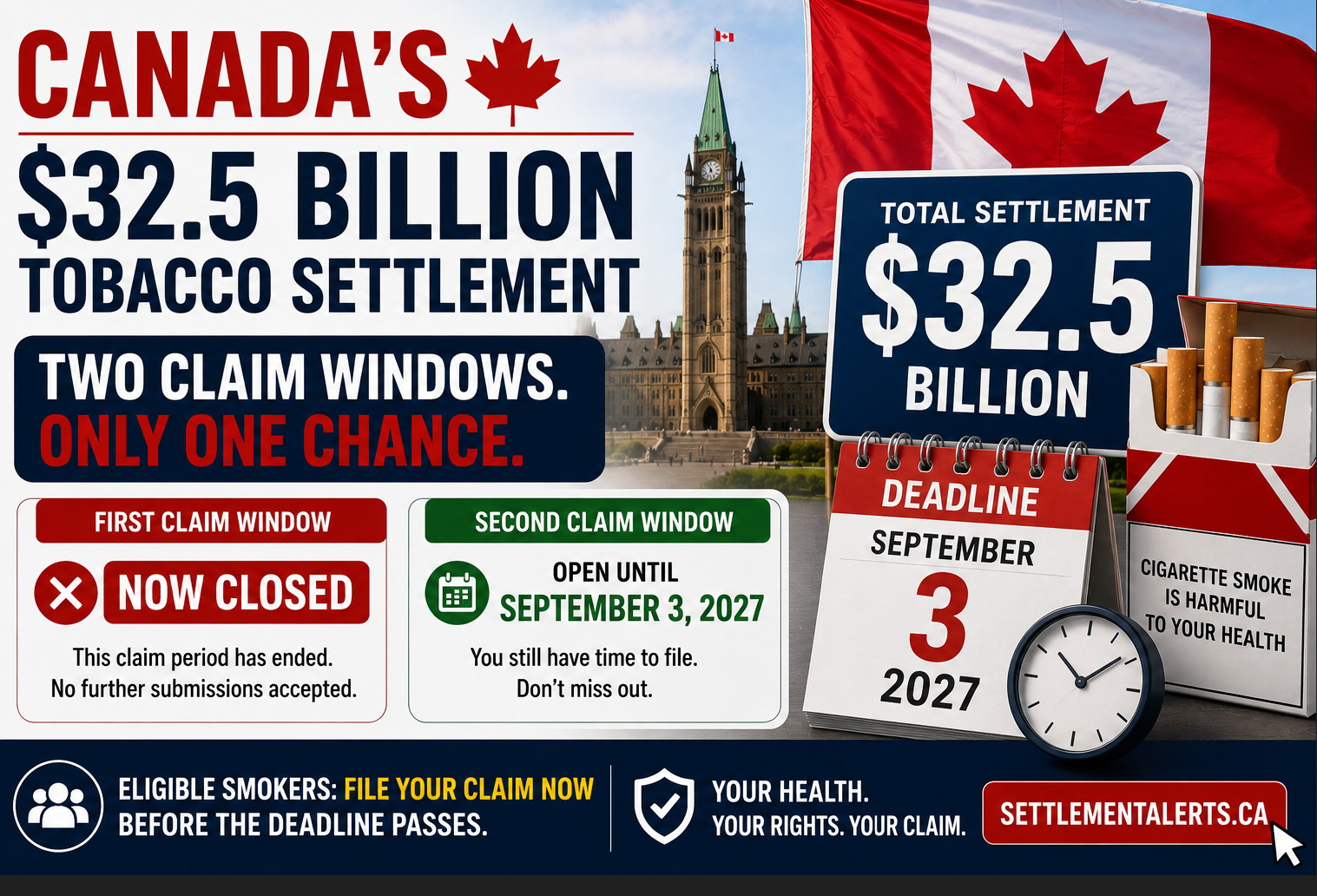
If you smoked for years, were diagnosed with lung cancer, throat cancer or severe COPD, and you have been waiting for someone to tell you when to file — one of the two claim windows in Canada’s tobacco settlement closed on August 31, 2026. It is not coming back. There is no extension.
The other one is still open. It runs to September 3, 2027, which is exactly one year from today.
Which window applies to you has nothing to do with where you live now. It depends on when you were diagnosed. Here is how to tell, and what the money actually looks like.
What closed on August 31
The QCAP plan — the Quebec Class Action Administration Plan — stopped accepting claims on August 31, 2026. The claims administrator’s own FAQ now states plainly that the submission period has closed and no new QCAP claims may be submitted.
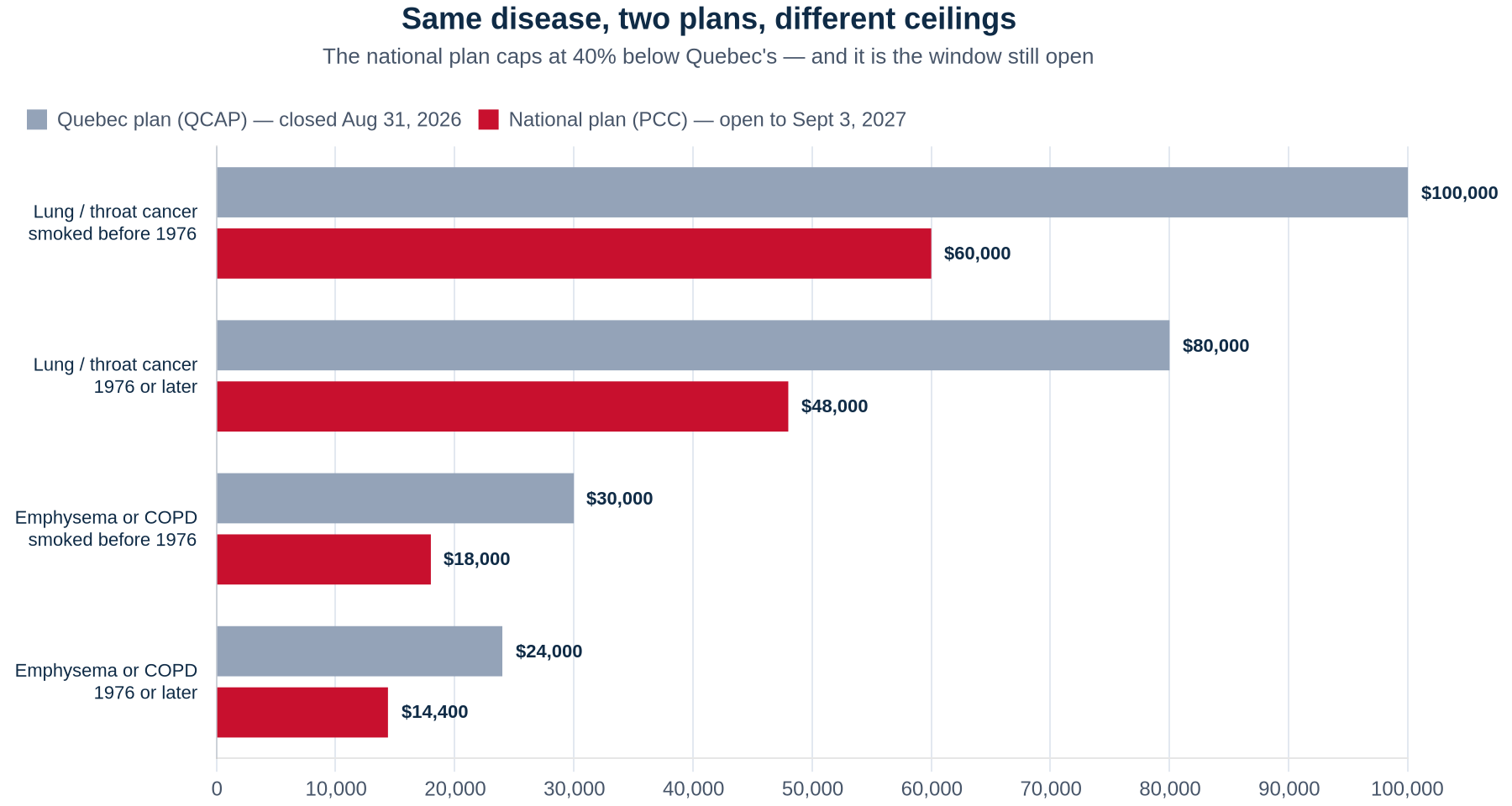
QCAP covered the two Quebec class actions, and it was the more generous of the two plans: up to $100,000 for primary lung or throat cancer, $30,000 for emphysema or COPD at GOLD Grade III or IV.
If you missed it, you missed it. Be careful here, because this is exactly the point where aggregator sites go wrong. Several “open settlements” lists still show tobacco claims as available without saying which plan they mean. One of the two is dead.
The window that is still open: the PCC plan
The Pan-Canadian Claimants’ Compensation Plan — PCC — opened on September 3, 2025 and closes on September 3, 2027. It is the national plan, and it is the one most Canadians outside Quebec will be looking at.
Deadline: September 3, 2027.
Where to claim: tobaccoclaimscanada.ca, run by Epiq Class Action Services Canada as court-appointed claims administrator. That is the only official route.
The four tests you have to pass
The diagnosis window is narrow. You must have been diagnosed between March 8, 2015 and March 8, 2019, inclusive. Not before. Not after. This is the single biggest reason claims get rejected, and it is the detail most likely to disqualify someone who has been told by a friend that they “should be able to get something.”
The disease has to be one of three. Primary lung cancer; primary squamous cell carcinoma of the larynx, oropharynx or hypopharynx (throat cancer); or emphysema or COPD at GOLD Grade III or IV. Milder COPD does not qualify. Your physician has to confirm the grade on a form.
You need twelve pack-years. The plan defines this as at least 87,600 cigarettes manufactured by the three tobacco companies and sold in Canada between January 1, 1950 and November 20, 1998. That works out to a pack a day for twelve years. The brands have to appear on the plan’s eligible-brand list.
You have to have been alive on March 8, 2019 and resident in Canada both at diagnosis and when the claim is submitted. Estates can claim for someone who met every criterion and died on or after March 8, 2019.
What the plan pays
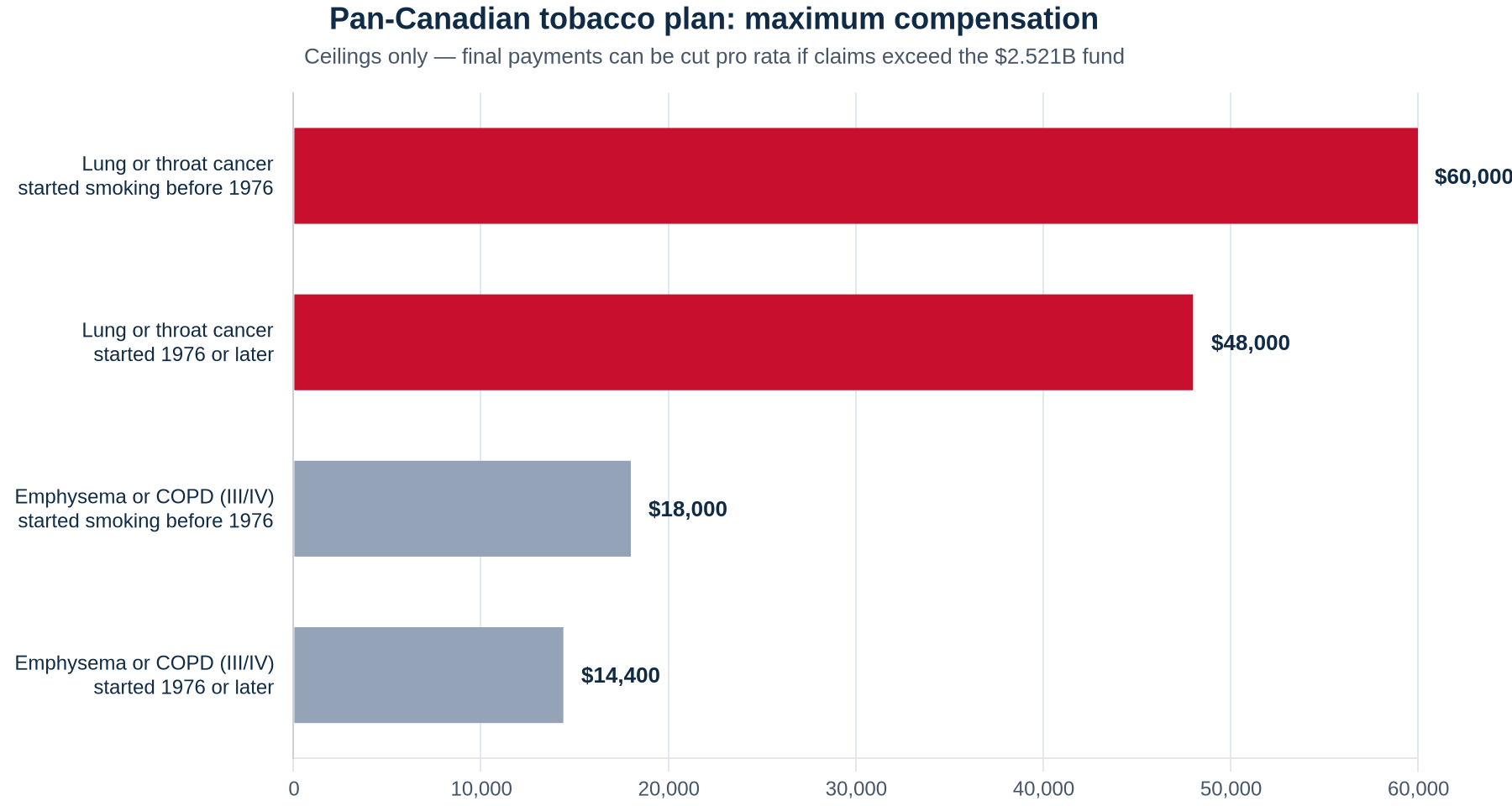
Maximums depend on the disease and on when you started smoking:
- Lung or throat cancer, started smoking before January 1, 1976: $60,000
- Lung or throat cancer, started on or after January 1, 1976: $48,000
- Emphysema or COPD (GOLD III/IV), started before 1976: $18,000
- Emphysema or COPD (GOLD III/IV), started 1976 or later: $14,400
Why the national numbers are lower
This is worth understanding, because it explains almost everything about how this settlement behaves.
This is not a normal class action settlement. It came out of an insolvency proceeding. The three tobacco companies filed for protection under the Companies’ Creditors Arrangement Act, and the Ontario Superior Court sanctioned the resulting plans on March 6, 2025. The total is $32.5 billion, paid out of the companies’ future operating profits rather than in one lump sum.
That total is carved up. The Quebec class actions got $4.25 billion. The pan-Canadian plan got $2.521 billion. A cy-près foundation, which funds tobacco-related disease research and programs instead of paying individuals, got $1 billion. The balance — by far the largest share — goes to provincial and territorial governments recovering decades of health-care costs.
In an insolvency, claims get compromised. The Quebec judgment on its own was worth over $13.5 billion; the settlement allocates $4.25 billion to those class actions. Individual smokers are one creditor group among several, and they are not the largest. That is why a lung cancer diagnosis is worth $60,000 here rather than what a court might have awarded after a full trial.
What you will actually be paid
Nobody knows yet, and be sceptical of any site that gives you a firm per-person number.
The figures above are ceilings, not cheques. The plan documents state that final payments may be reduced on a pro-rata basis if the $2.521 billion allocated to the PCC plan is not enough to cover every approved claim. How much it is reduced depends entirely on how many valid claims arrive before September 3, 2027 — a number that will not be known until after the window closes.
The practical takeaway is the same one that applies to the CIBC mutual fund settlements: file if you are eligible, and do not decide in advance that your share is too small to bother with. You cannot know until distribution, and filing costs you nothing.
What to do this week
Find the diagnosis date first. Everything turns on whether it falls between March 8, 2015 and March 8, 2019. Before you gather anything else, confirm that date from a medical record. If it sits outside that window, the PCC plan is not for you and no amount of paperwork will change that.
Start requesting medical records now, not next summer. A year sounds like plenty of time. It is not, once you factor in hospital records departments, a physician form that someone else has to complete, and proof of the brands you smoked. People who leave this to the last month are the ones who miss it.
Do not pay anyone to file for you. The claim process is free, and Epiq’s PCC Agent will help you at no charge on 1-888-482-5852. The administrator’s own guidance is blunt about this: you are not required to hire a lawyer, and if you do, it will likely reduce what you receive. Anyone charging an upfront fee to “process your tobacco settlement claim” is taking money out of a payment you can get for nothing — the same warning we have run on the CRA data breach settlement and every other open claim.
Expect the phishing to follow. Any settlement of this size attracts calls and emails claiming to be from the administrator, asking for your SIN, banking details or a “processing fee” to release your payment. The real administrator does not cold-call for banking information. If you get an unexpected message, do not use the link in it — type tobaccoclaimscanada.ca into your browser yourself, or phone the number above.
Check the estate route if the person has died. This plan covers people who were alive on March 8, 2019 and died afterwards. Families frequently assume a death closes the file. It does not, and the estate forms are on the same official site.
If you are tracking several claims at once, note that the Silk and Great Value recall settlement closes on October 16, 2026 — nearly a year before this one. Deadlines that feel distant are the ones people lose.
More open settlements
- Two CIBC Mutual Fund Settlements Are Open at Once — Which One Applies
- $7.5M Silk and Great Value Recall Settlement: Who Can Actually Claim
- Scotiabank $10.45M Settlement: Are You One of the 148,000?
- The GST/HST Credit Is Gone — What Replaced It and What Lands October 5
Figures and deadlines in this article are as of September 3, 2026, and are taken from the court-appointed claims administrator’s plan documents. This is general information, not legal or financial advice. Settlement terms, eligibility rules and deadlines can change. Confirm every detail on the official settlement website at tobaccoclaimscanada.ca, or with class counsel, before you file or rely on anything here.

Tyler Bernick is a content writer covering Canadian settlement updates, scam alerts, and consumer rights. He aims to simplify complex legal topics and provide clear, reliable information to help Canadians make informed decisions.
Discover more from Settlement Alerts
Subscribe to get the latest posts sent to your email.