
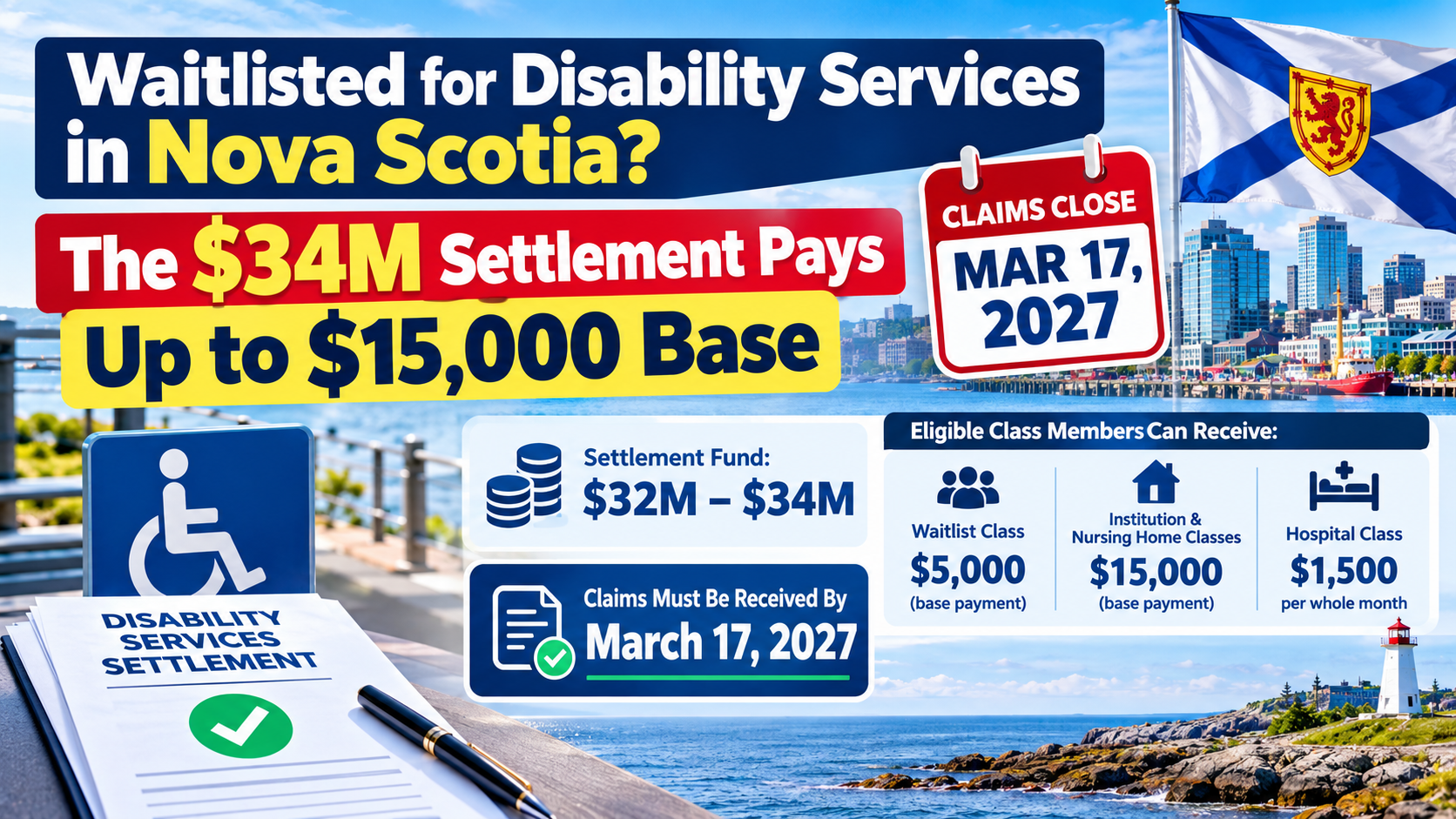
If you, or someone you care for, spent time on Nova Scotia’s waitlist for disability services, there may be money set aside for you — and it is easy to miss.
The Province of Nova Scotia settled a class action over how it ran the Disability Support Program. The deal is worth up to $34 million. Base payments are $5,000 for six months or more on the waitlist and $15,000 for three months or more in an institution or nursing home.
Claims are open now and close March 17, 2027. That sounds like a long way off. It is not, if the claim has to go through a guardian, an executor or a family member gathering paperwork.
Who this covers
The settlement covers people who were eligible for disability services under Nova Scotia’s Social Assistance Act between April 1, 1998 and August 20, 2025, and who were either kept waiting for those services or placed somewhere they should not have been while they waited. You also had to be alive on May 4, 2022, the day the lawsuit was filed.
There are four classes, and you can belong to more than one:
- Waitlist Class: people on the waitlist for disability services, other than a residential placement for seniors.
- Institution Class: people who lived at a Regional Rehabilitation Centre, Adult Residential Centre or Residential Care Facility while eligible for services.
- Nursing Home Class: people who lived in a nursing home and had been assessed by the Department of Community Services as having needs that fell under the Disability Support Program.
- Hospital Class: people kept in the Nova Scotia Hospital, or another provincial hospital, with no medical reason to be there.
Children cannot claim as class members. The administrator’s FAQ explains why: people under 19 were not eligible for the Disability Support Program in the first place.
What the payments are
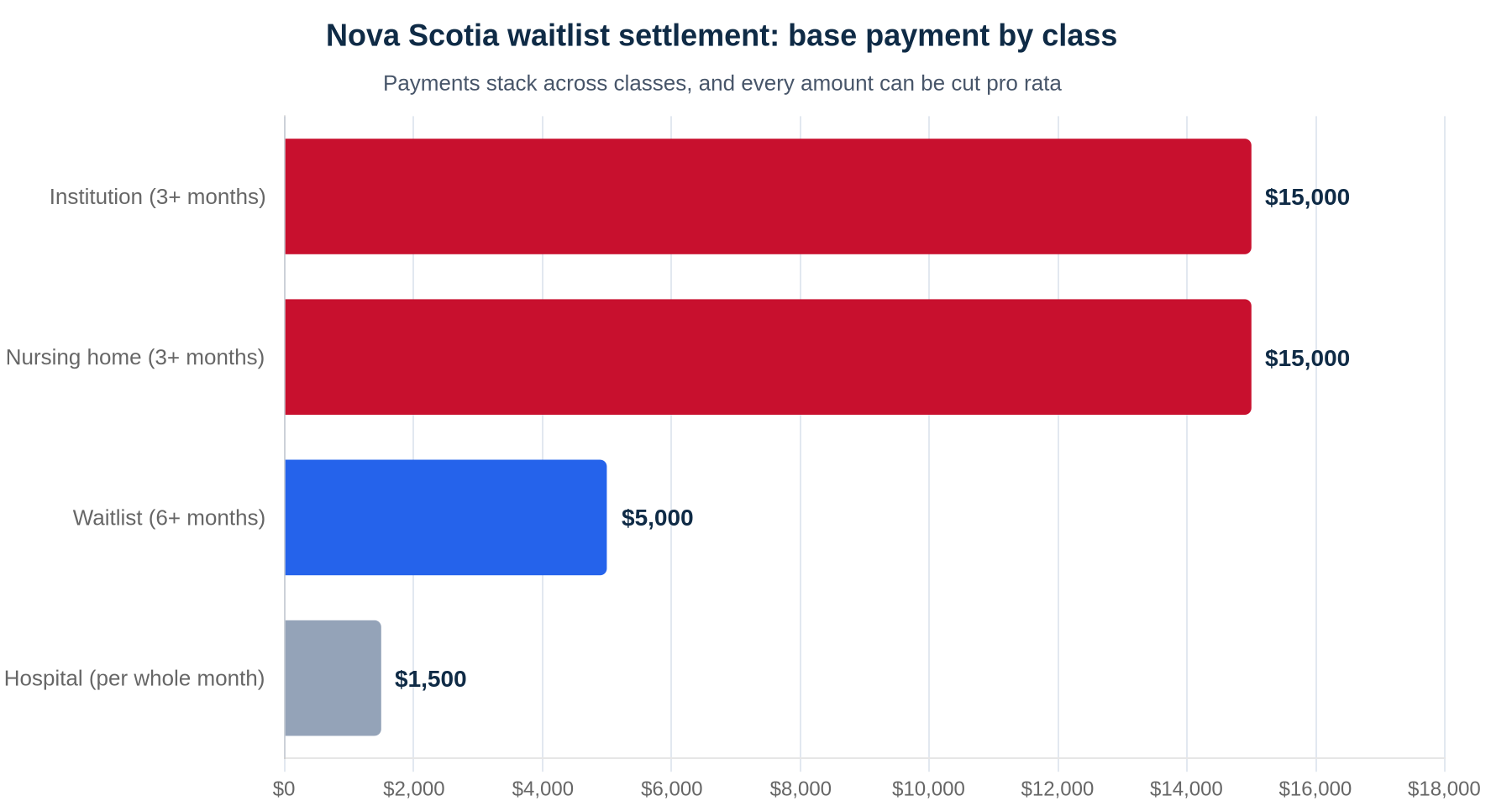
Payment depends on how long you were in each class. These are the figures in the court-approved Compensation Protocol:
- Waitlist: $5,000 for at least six months, plus $500 for each additional 12 months.
- Institution: $15,000 for at least three months, plus $1,500 for each additional 12 months.
- Nursing home: $15,000 for at least three months, plus $1,500 for each additional 12 months.
- Hospital: $1,500 for each whole month.
The amounts stack. The administrator’s own example is a woman who spent six months on the waitlist and then three months in an institution. She could be eligible for $5,000 plus $15,000, or $20,000.
Two things the settlement website says plainly: payment does not affect your provincial social assistance, and it does not start until every claim has been reviewed.
The May 2020 cut-off
This is the rule most likely to catch people out. Nova Scotia has a two-year limitation period, and the lawsuit started on May 4, 2022. So time from May 4, 2020 to August 20, 2025 is assessed the normal way.
Time before May 4, 2020 only counts if you can show you were legally incapable of starting a lawsuit yourself back then — meaning you could not make reasonable decisions about your money or legal affairs. If the Province’s records do not already show it, the FAQ lists evidence that can: Public Trustee records, an order under the Adult Protection Act or Incompetent Persons Act, or hospital or psychiatric records.
If you, or the person you are claiming for, spent years on the waitlist before 2020, start gathering that evidence now. It is the slow part.
Why nobody can tell you your final number
Every figure above is a maximum, not a promise. The fund is fixed, and if approved claims add up to more than the money available, everyone’s payment is cut pro rata. If claims come in lower than expected, there may be more to go around. Nobody knows yet which way it will go, and you should be sceptical of any site that gives you a firm per-person number.
Here is the mechanism. The Province pays $32 million up front. It adds up to $2 million more only if enough approved claims come from people who were legally incapable before May 2020. Out of that money comes everything — not just compensation.
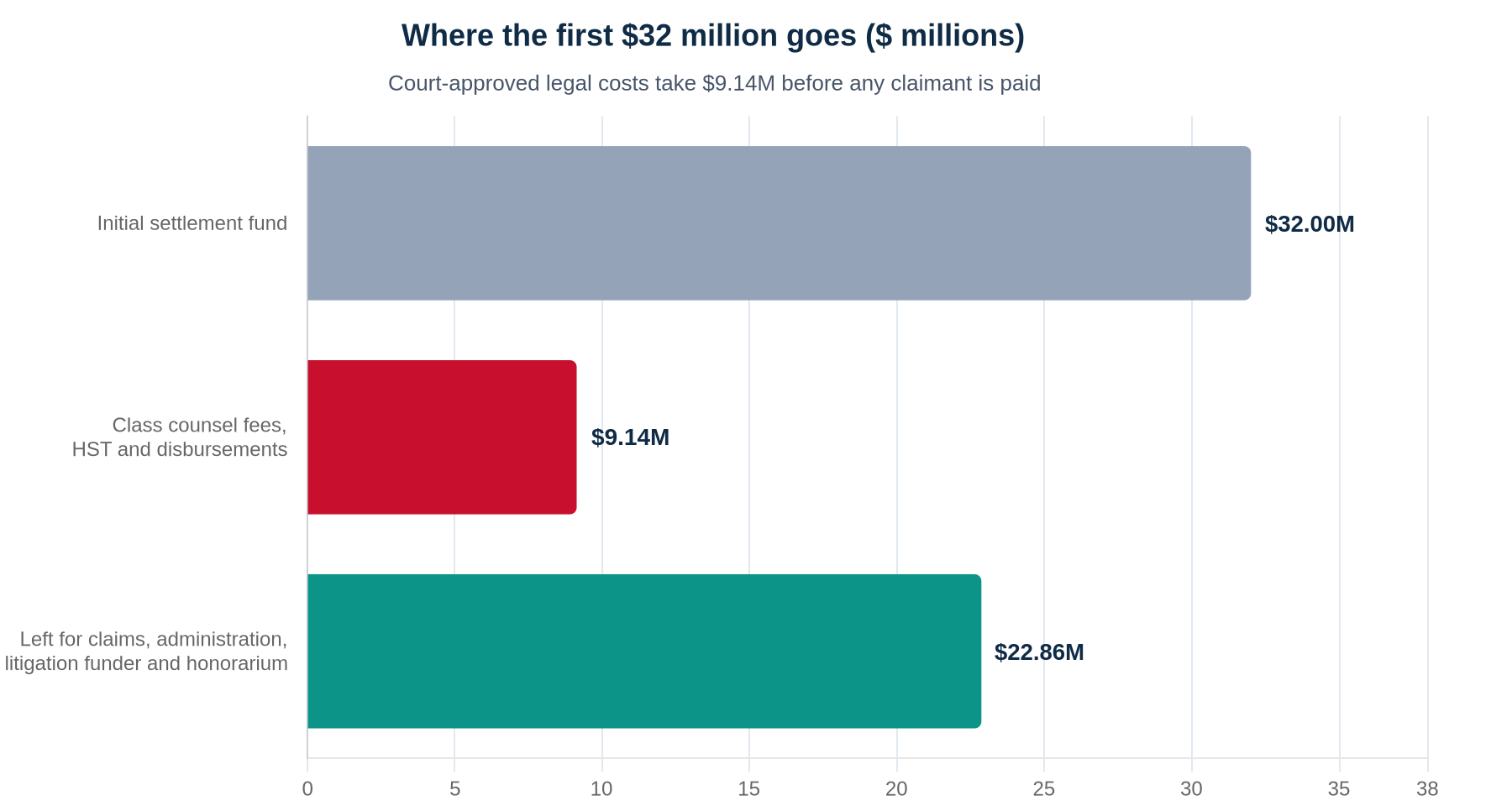
The court approved class counsel fees of $8 million, plus $1.12 million in HST and $18,540.09 in disbursements. That is about $9.14 million off the top. Administration costs, a fee to the litigation funder and a $15,000 honorarium for the representative plaintiff also come out of the fund. Class counsel has said it will take no fee on the extra $2 million if it is triggered.
This is the same pattern we saw in Manitoba’s $445M Children’s Special Allowance settlement: the headline number is the ceiling, and what reaches each person depends on how many people file.
How to claim
Claim Form 1 is the application. If you are claiming for yourself, the FAQ says all you need is your contact information, your date of birth and a copy of government-issued ID. If you have no ID, Part 3B of the form has a Declaration of Identity instead. You tick which classes you belong to. The dates and places you were placed are optional — leave them blank if you do not know — because the Province checks its own records.
If you are claiming for someone else, you also need a second form:
- Claim Form 2 for a legally appointed Personal Representative of someone who cannot claim themselves.
- Claim Form 3 for the executor or administrator of a deceased class member’s estate, with proof of death and of your appointment.
- Claim Form 4 for a relative where no executor was appointed. This one asks the most: proof of relationship, details of other family members, a sworn declaration and two supporting statements. Only the nearest relative can receive the money.
You can file online through the claims portal at Portal.NSWaitlistSettlement.ca, by email to Claims@NSWaitlistSettlement.ca, by fax to 902-450-4956, or by mail to Deloitte LLP, PO Box 998 STN Central, Halifax, NS B3J 2X1. Everything, including supporting documents, must be received by March 17, 2027.
There is a 90-day grace period to June 15, 2027, but only if you can show the delay was caused by your disability, by circumstances outside your control, or by something exceptional. Do not plan around it.
What to do this week
Check whether you, or someone in your family, fits a class. Think back to any time spent waiting for Disability Support Program services, or living in a residential centre, nursing home or hospital while eligible.
Find the paperwork if a representative is filing. Guardianship orders, probate documents and death certificates take time to locate or request. Start now, not in February.
Gather incapacity evidence for pre-2020 time. If the claim includes waitlist years before May 4, 2020, that evidence decides whether those years count.
Use the official channels only. Go to the settlement page at classaction.deloitte.ca, call the administrator at 1-844-677-1771, or call class counsel at Koskie Minsky (1-877-309-9111) or McKiggan Hebert (902-706-2298). The court notice says class counsel will not charge you for help with your application.
Never pay anyone to file. Filing is free. Anyone offering to “get your settlement faster” for a fee or a percentage is not doing you a favour. The same goes for texts or emails asking for your SIN or banking details to “release” a payment. There is no release fee. If a message is unexpected, do not click it — call the administrator at the number on the official website. We have seen the same playbook around the Government of Canada account breach settlement.
If you get federal disability support too, our explainer on the $150 Canada Disability Benefit top-up covers the separate federal payment.
More open settlements
- B.C.’s $66M Birth Alerts Settlement — claims are open before court approval
- Manitoba’s $445M CSA Settlement — closes January 5
- Ontario Jail Lockdown $59 Million Settlement
- Canada’s $32.5 Billion Tobacco Settlement — runs to September 3, 2027
Figures and dates are as published by the claims administrator, Deloitte LLP, and in the court-approved notice and FAQ as of October 2, 2026. All compensation amounts may be reduced or increased pro rata depending on the number of approved claims. This article is general information, not legal or financial advice. Confirm your eligibility on the official settlement website or with class counsel before you rely on it.

Tyler Bernick is a content writer covering Canadian settlement updates, scam alerts, and consumer rights. He aims to simplify complex legal topics and provide clear, reliable information to help Canadians make informed decisions.
Discover more from Settlement Alerts
Subscribe to get the latest posts sent to your email.