
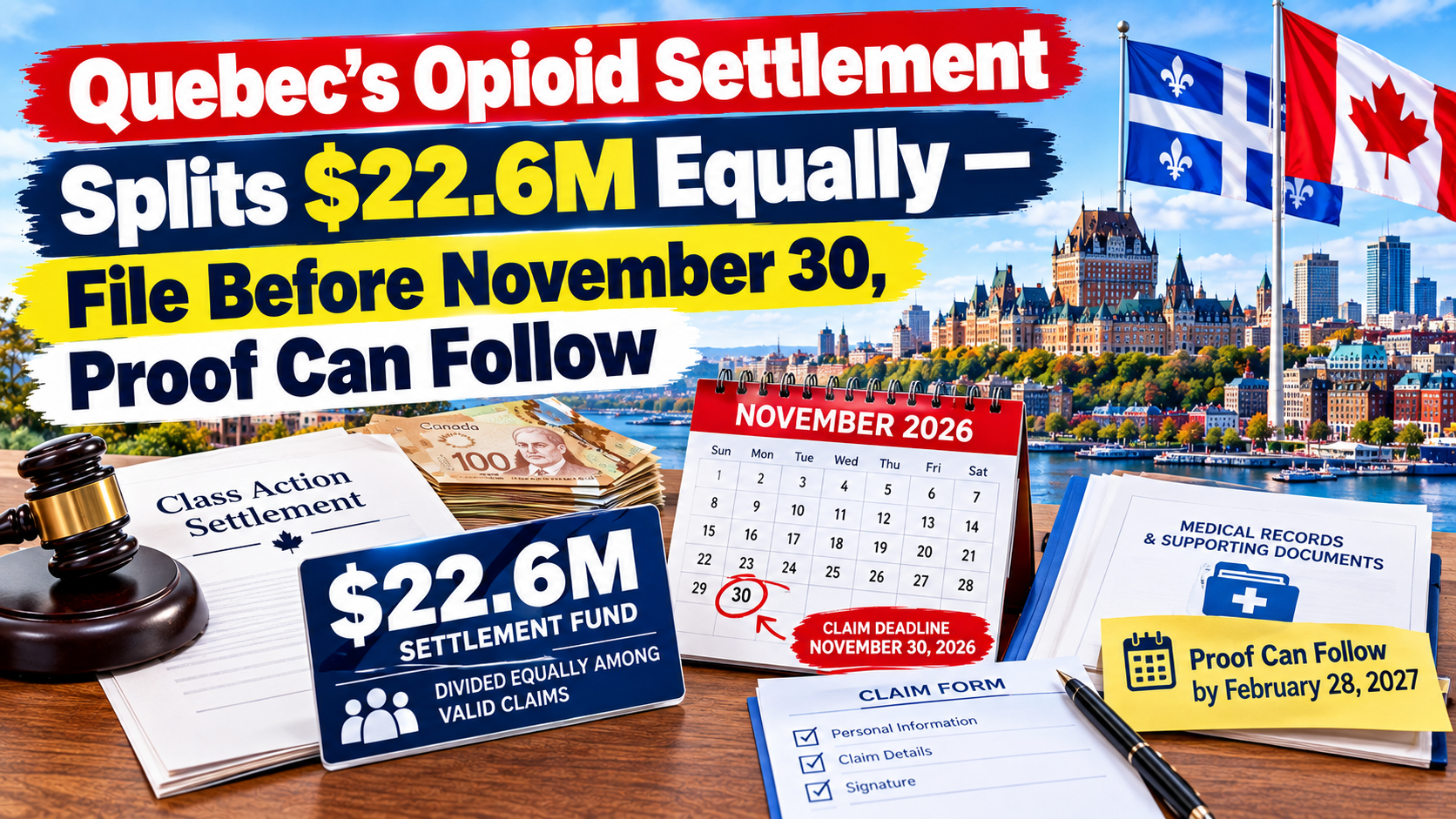
If you live in Quebec, were prescribed opioids at any point since 1996, and were later diagnosed with or treated for opioid use disorder, there is about $22.6 million set aside to be shared equally among people like you. You have to ask for it.
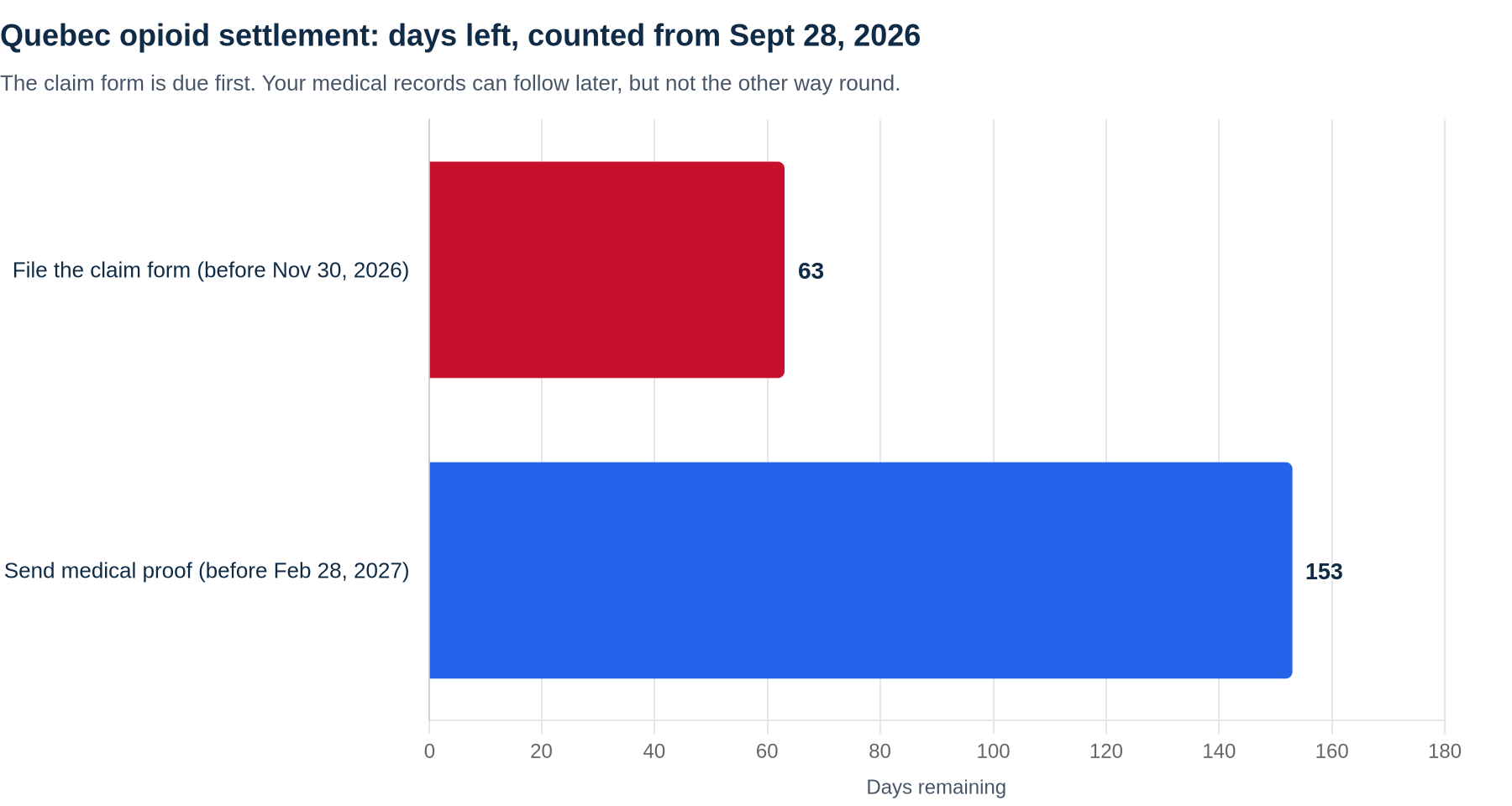
The claim form has to reach the administrator before November 30, 2026. Nobody signs you up automatically, and there is no payment without a claim.
There is a second deadline too. Your medical proof can come later, up to February 28, 2027. That split is the most useful thing to understand about this claim: don’t wait on paperwork to send the form.
What this settlement is
This is a Quebec class action against opioid manufacturers. It was brought for Quebecers who developed opioid use disorder after being prescribed opioids. Some of the companies settled without the case going to trial. The Quebec Superior Court approved those settlements and a distribution plan on January 12, 2026.
Class counsel lists eight settlement agreements. The companies named include Pfizer Canada, Apotex, Abbott Canada, Bristol Myers Squibb, Ethypharm, Laboratoire Atlas, Pro Doc and Purdue. The case continues against the companies that did not settle. That could mean more money later, but nothing is promised.
Court file: Quebec Superior Court, No. 500-06-001004-197.
Claims administrator: MNP Ltd.
Class counsel: Trudel Johnston & Lespérance and Fishman Flanz Meland Paquin.
Who can claim
You are in the class if you meet all three of these conditions:
- You are a Quebec resident.
- You were prescribed an eligible opioid and took it, at any time from 1996 onward.
- You were diagnosed with or treated for opioid use disorder.
The direct heirs of someone who died and met these conditions can also claim, with a death certificate and proof that they are an heir.
Which drugs count
The administrator publishes a list of eligible products. It covers prescription products containing codeine, fentanyl, hydromorphone, morphine, oxycodone, tramadol, methadone, buprenorphine, meperidine and a few others, including common combination pills such as codeine with acetaminophen. Check the list against your prescriptions. Don’t assume.
Excluded: OxyContin and OxyNEO. Those brands were the subject of a separate, earlier class action. Its claim period is not open now. Class counsel says hospital-only medications are also excluded.
How much you could get
Nobody knows yet. The administrator says about $22.6 million will be divided equally among everyone with a valid claim, and that the per-person amount has not been set. The court-approved distribution protocol puts the total from the settling companies at a little over $31 million. Under that protocol, court-approved legal fees and administration costs are paid first, and claimants share what is left.
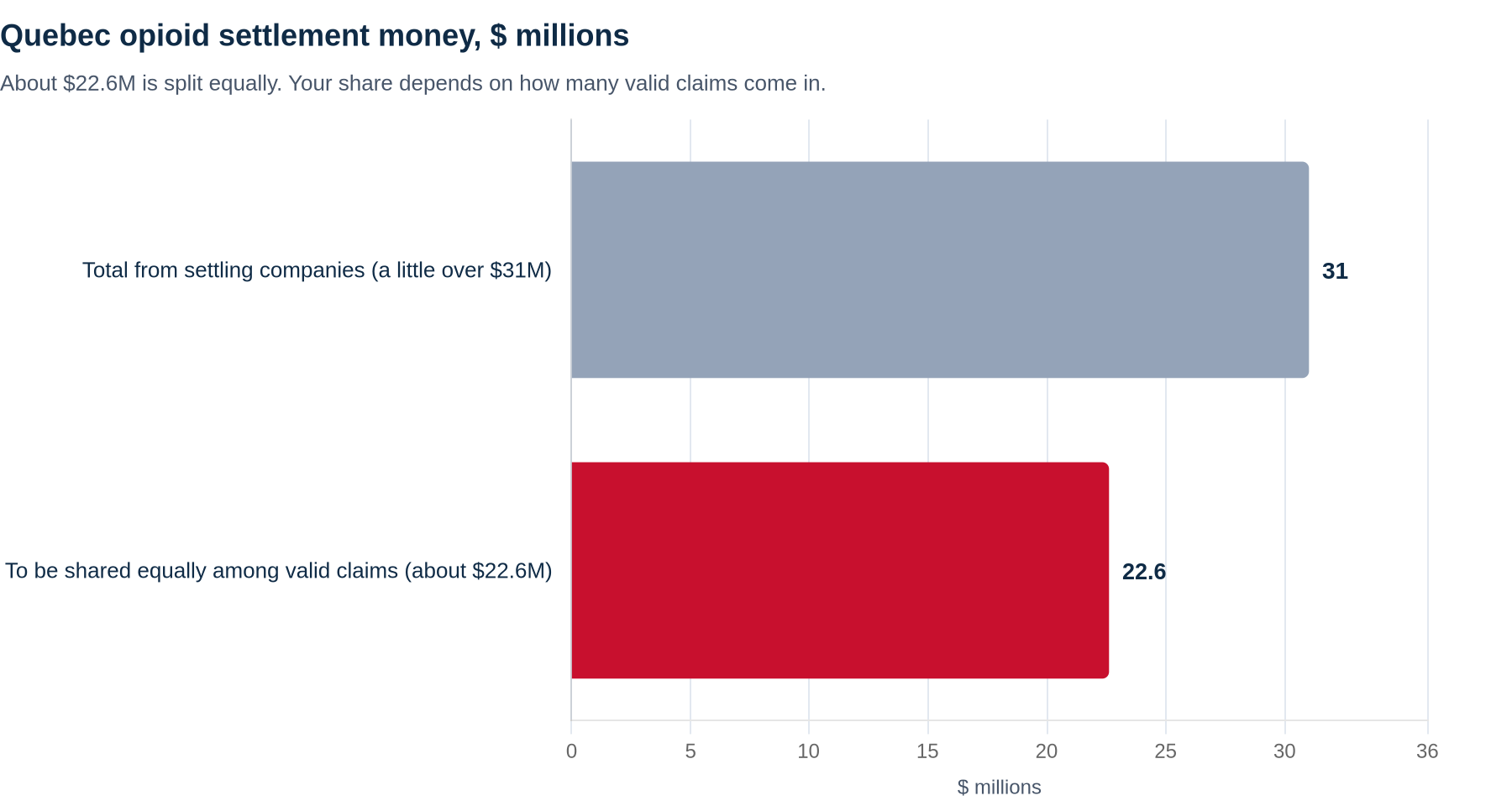
Equal shares mean your payment depends only on how many valid claims come in. If 2,000 people qualify, each share is large. If 20,000 qualify, it is much smaller. Nobody knows the final number of claims, so be sceptical of any site that gives you a firm per-person figure. The protocol also lets class counsel ask the court to cap payments if shares turn out to be unreasonably small and to hold some money back for later distributions.
What you need to prove
This claim needs documents. It is not a simple “I bought the product” declaration like the Truffettes de France settlement. You need three things:
Proof you used an eligible opioid: a prescription, a pharmacy invoice, or a note in your medical record or written by a doctor or other health professional.
Proof of the diagnosis or treatment: a doctor’s note, an extract from your medical or hospital record, or an extract from RAMQ or Ministry of Health and Social Services databases.
ID: valid government photo ID, such as a health insurance card or driver’s licence.
You don’t have to chase every record yourself
Section 7 of the claim form lets you authorize class counsel to request your RAMQ and pharmacy records for you. You can also list the hospitals, CLSCs, clinics and pharmacies where you were treated, and ask the lawyers to make access requests there. Records requests take time, and the later proof deadline gives you room for that.
If your file is missing something, MNP sends an “incomplete file” notice, and you can fix it before the period closes. The protocol allows late claims within 30 days after the period ends only for valid reasons. Treat November 30 as a hard deadline.
How and when you get paid
Payments go out by cheque or Interac e-Transfer, whichever you pick on the form. No payment date has been published, and payments can’t be calculated until every claim is reviewed. Watch the expiry dates when money does arrive. Under the protocol, cheques not cashed within six months and e-Transfers not accepted within 30 days go back into the fund.
Watch for scams
Filing is free. You don’t need to pay anyone to file this claim. Class counsel is paid from the settlement with the court’s approval, not by you. Be wary of any company that offers to “handle” your opioid claim for a percentage.
Scammers follow payouts. Use only MNP’s own site, phone line and claims email. A real claims administrator doesn’t charge a fee to release a payment. A text or email asking for your banking details or health card number to “confirm eligibility” is phishing. Go to MNP’s settlement page directly instead of clicking a link.
What to do this week
Check the eligible-drug list. Open the list on MNP’s Quebec opioid page and compare it with what you were prescribed. If the only product you took was OxyContin or OxyNEO, this settlement doesn’t cover you.
File the claim form now, even without records. The form is due before November 30. Proof can follow until February 28, 2027. Filing first protects your place.
Tick the records authorization. If you don’t have your pharmacy or RAMQ history, let class counsel request it. Write down every clinic, hospital and pharmacy you can remember.
Claim for a family member who has died, if it applies. Direct heirs can file. Start gathering the death certificate and estate documents now.
Call the administrator if you’re unsure. MNP’s claims line is 1-844-285-6678, and the email is quebecopioidsettlement@mnp.ca. The line is toll-free.
Other claims are closing soon too. The CAF racism claim closes October 15. And if you have a smoking-related illness, the tobacco settlement still has a claim window open to September 3, 2027.
More open settlements
- exo train-delay settlement: up to $145, claims close October 20
- Two CIBC mutual fund settlements: which one applies to you
- Government of Canada account breach settlement
- Every settlement deadline closing in October
Figures and deadlines are as of September 28, 2026, from the claims administrator (MNP Ltd.), the court-approved distribution protocol and class counsel. This is general information, not legal or financial advice. Confirm your eligibility and deadlines on the official settlement website at MNP.ca/QCopioid or with class counsel.

Tyler Bernick is a content writer covering Canadian settlement updates, scam alerts, and consumer rights. He aims to simplify complex legal topics and provide clear, reliable information to help Canadians make informed decisions.
Discover more from Settlement Alerts
Subscribe to get the latest posts sent to your email.